
We need to better understand what quantum computers are good at, and what we can use them for; they are not useful for everything. They could potentially bring benefits such as quadratic or exponential speedups, or better accuracy, but first one must identify what problems lend themselves well to quantum computation. One of the tallest hurdles of quantum computing is how abstract the concept is. It is not intuitive, nor an easy topic to cover. It requires education about what can and cannot be done.
We don’t expect children to understand Newtonian Mechanics before they figure out how fast to run to meet a ball, or how hard to throw to make a ball land where they want. On the contrary, the experience of playing with a ball can help children later understand a mathematical description of gravity and Newton’s equations of motion. Quantum theory describes phenomena that are less obvious, phenomena that are harder to witness, if you are not an experimental physicist working in a lab. Games offer an easy way to think about real world problems. Using a game to get an intuition of how quantum systems work, is an accessible way to learn the core ideas of quantum computing.
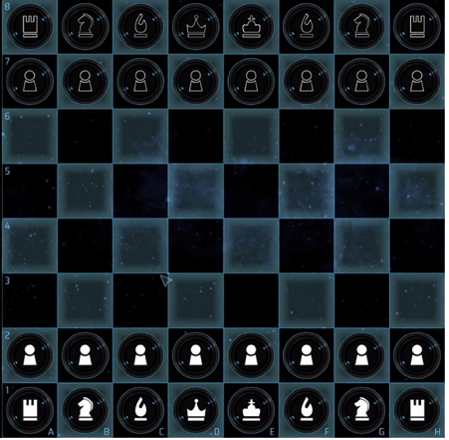
This year, Moody’s celebrated World Quantum Day (April 14th) with Quantum Realm Games. Their flagship game, Quantum Chess, enabled everyone at Moody’s to learn about quantum computing, regardless of their background. Quantum Chess brings the principles of quantum mechanics to life on the chessboard. While the game appears to work like traditional chess, players can make a few extra moves that dramatically change the strategy involved. These additional moves are grounded in quantum concepts.
The moves allow players to develop their intuition about quantum mechanics, just by playing. For example, one of the four key principles of quantum mechanics is the concept of quantum superposition. This concept suggests that the state of any particle in the universe is fundamentally unknowable, until you interact with it. (Interaction is a form of measurement, which is another of the four key principles.)
In Quantum Chess, the player can experience quantum superposition as a single piece in multiple positions on the board. When the player decides to create a quantum superposition with one of their pieces, they “split” the game into multiple universes.
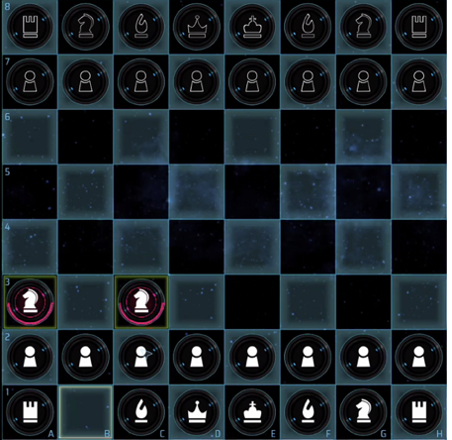
Quantum Chess elegantly presents one game, played in two universes that can evolve independently, on a single board. In which universe are our players playing? They must measure to find out! Under the hood, the Quantum Chess game engine tracks every move using the same mathematics that are used to describe quantum mechanics. The chess board itself is a quantum system, from the game engine’s perspective. In fact, Quantum Realm Games is the first consumer quantum company to run their software on Google’s quantum computer. Thanks to the game's design, players get to interact with a real quantum system, without having to first study for a PhD in quantum physics.
Quantum Chess enabled everyone to speak the same language and ask questions about how to leverage the properties they were learning about in real world problems. It also sparked their interest to jump into the quantum realm to learn more. We want to thank Quantum Realm Games for making quantum theory accessible to anyone who can play a game. We felt that this ingenious way of helping people build intuition about quantum information science can be useful for many people, and we were happy for them to join us on World Quantum Day.
Would you like to learn to play quantum chess? Watch a game led by Ricardo Olenewa, partner at Quantum Realm Games.