


In our previous article, “Climate scenario analysis: integrating physical and transition risks to find opportunities,” we looked at using climate scenario analysis to identify transition risk opportunities.
By analyzing two different climate scenarios, one above 2°C and one below 2°C, analysts can start quantifying the asset class impacts they might expect to occur. Comparing the two scenarios with a “climate underpriced” baseline, it is possible to identify both physical and transition risks. Figure 1 illustrates how this can be accomplished.
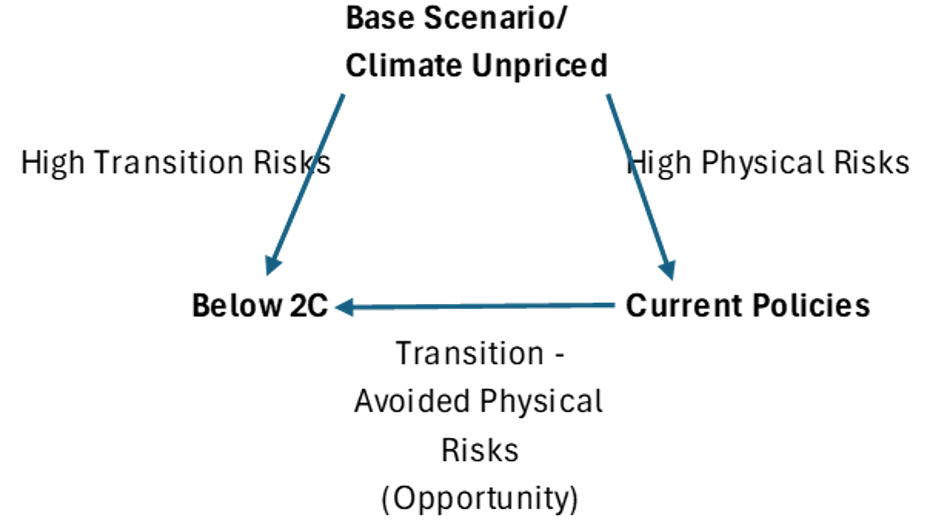
Figure 1: Climate scenarios quantifying climate risks (physical and transition) and transition opportunities.
In this article, we consider the inherent uncertainties associated with climate science and economics and how they can impact this type of analysis.
There are several different alternative scenarios stakeholders and advocates might suggest. Rigorously tackling uncertainties is central to a scientific analysis of the problem and essential for building a longer-term strategic understanding.
As our list illustrates, climate science and carbon transition, although widely studied, remain deeply uncertain, and the potential impacts are widely disputed:
- More severe levels of global warming and climate change including “tipping point” scenarios. Given the repricing effects outlined above, these types of scenarios will produce higher levels of both physical and transition risks. While the transition opportunity will likely be significantly weighted to the upside, the policy dilemma is accentuated as the repricing is more severe in both scenarios.
- More severe economic sensitivities. These can be explored by looking at alternative estimates for the damage functions. This type of scenario analysis will have similar impacts as above, meaning higher levels of both physical and transition risks but more transition opportunity. The Network for Greening the Financial System (NGFS) has published Phase V scenarios with much more significant damages, so this can be explored by updating previous work leveraging NGFS scenarios.
- More ambitious climate policies. By substituting a 1.5°C scenario for the below 2°C scenario, we can explore the implications of stronger climate policies. This typically leads to a higher level of transition risks, while the impact of transition opportunities may be more balanced (more avoided damages but more abatement and investment is required). Inflationary impacts can also be higher.
- Disorderly climate policies. By substituting a disorderly transition scenario for the below 2°C scenario, we can explore the impact of a disorderly transition. This will typically increase the transition risks and decrease the transition opportunities while physical risk holds constant.
- Different technological assumptions. By studying different integrated assessment models or scenario providers, for example, the Principles for Responsible Investment (PRI) or the International Energy Agency (IEA), we can explore the uncertainties associated with transition. For example, alternative transition scenarios can help explore the extent to which different sectors (such as renewables versus nuclear) fill the primary energy demand and the scope for different carbon capture and nature-based solutions.
- Exploring the impact of “green growth” on expected outcomes. Green growth (usually defined as an increase in broader economic productivity as a result of transition) will generally decrease the level of transition risks and increase the opportunities.
- The timing of both policy and market responses to climate. This may involve stressing the time frame for repricing (in climate pathways, we have options to look at immediate, gradual, and deferred repricing) but could also involve looking at delayed policy responses, most typically over a five-to-10-year horizon.
- Exploring the compounding impact of alternative sources of risks. By switching from a deterministic to a stochastic scenario-based analysis, it is possible to explore important impacts like the potential increase in extreme market tail events and possible deterioration in capital reserves.
Recognizing uncertainty
Given the broad range of different uncertainties, many financial risk practitioners may struggle to confidently interpret the result of climate scenario work. However, model validation and model risk are two common examples of uncertainty analysis and should be a core competency for risk managers and analysts as well as senior management. It is essential to recognize uncertainty analysis as distinct from risk analysis and not to merge the two inappropriately. Fundamental uncertainty is substantially different than risk. One approach we would recommend is exploring uncertainties via a systematic exercise in sensitivity analysis. By starting with the simple comparison of two alternative climate scenarios, analyzing physical risks, transition risks, and opportunities as illustrated, we can see how different sources of uncertainty affect results while possibly iterating the core scenarios being used in the business.
One issue that becomes apparent when we pursue this approach is that to balance the costs and savings associated with transition opportunities, it’s important to take a portfolio perspective. This has been well documented as the basis of the universal ownership theory. In practice, universal ownership advocates have become dependent on a green growth narrative, which is not widely believed. What might instead be more widely accepted is the case for a universal owner’s haircut, a willingness to write down and apply a capital haircut to current asset valuations, particularly the likely expected cash flows that can be generated from a diversified portfolio of assets.
Resources:
Jackson, Tim. 2018. “The Post-Growth Challenge.” 12. Centre for the Understanding of Sustainable Prosperity. www.cusp.ac.uk/publications.
Hahnel, Robin. 2013. “The Growth Imperative: Beyond Assuming Conclusions.” Review of Radical Political Economics 45 (1): 24–41. https://doi.org/10.1177/0486613412447056.
GET IN TOUCH
Speak to our team
For more information on Moody’s Climate Scenario Modeling, please visit our climate risk for insurers page or contact us today to schedule a conversation with our experts.