

Tackling the greatest nightmare for many quantum algorithms: state preparation — Moody’s at ETH Zurich Quantum Hackathon
Moody’s proudly sponsored the ETH Zurich Quantum Hackathon 2025 for the third year in a row. From May 9-11, our quantum team headed to Zurich, Switzerland, to present an interesting challenge on state preparation.
The event was a huge success, bringing together 130 brilliant students from diverse universities and backgrounds to push the boundaries of quantum computing and tackle real-world hardware challenges.
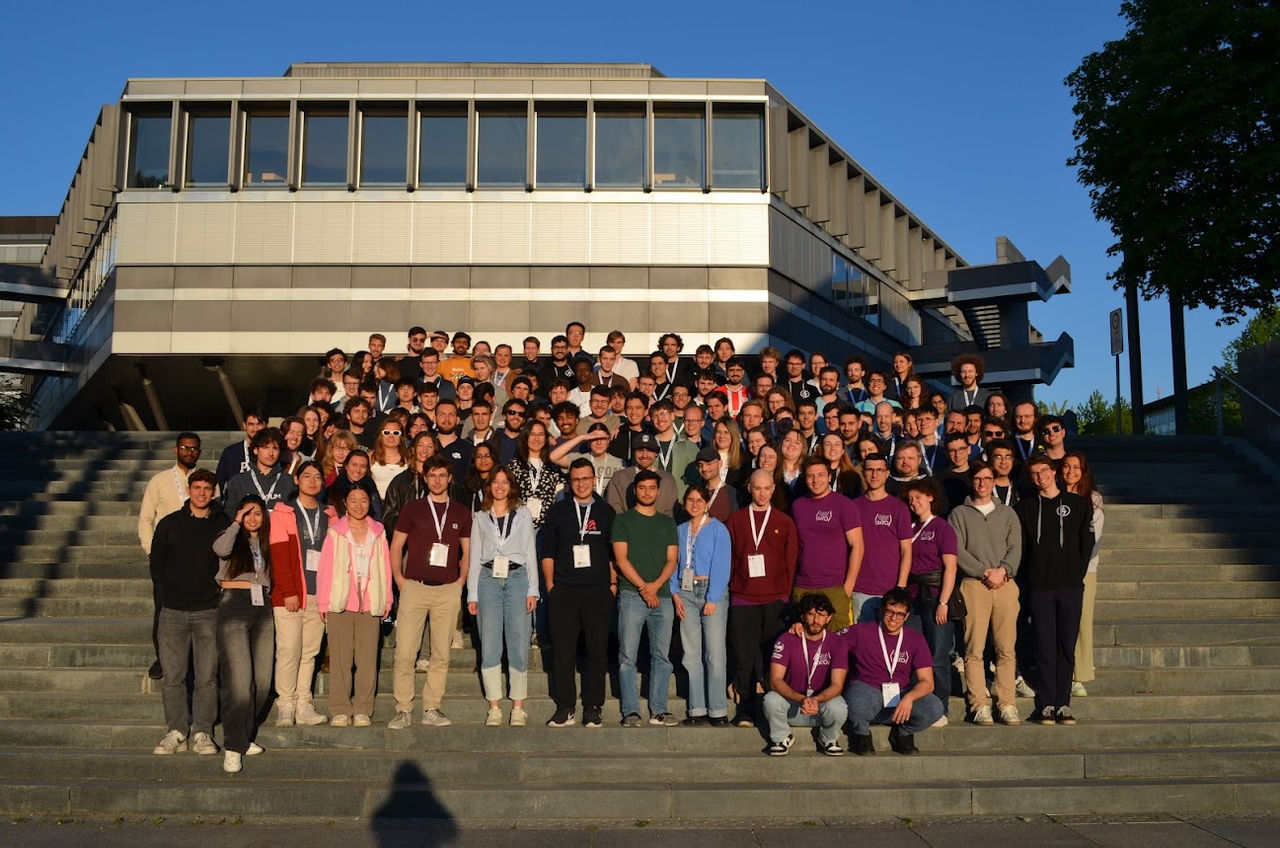
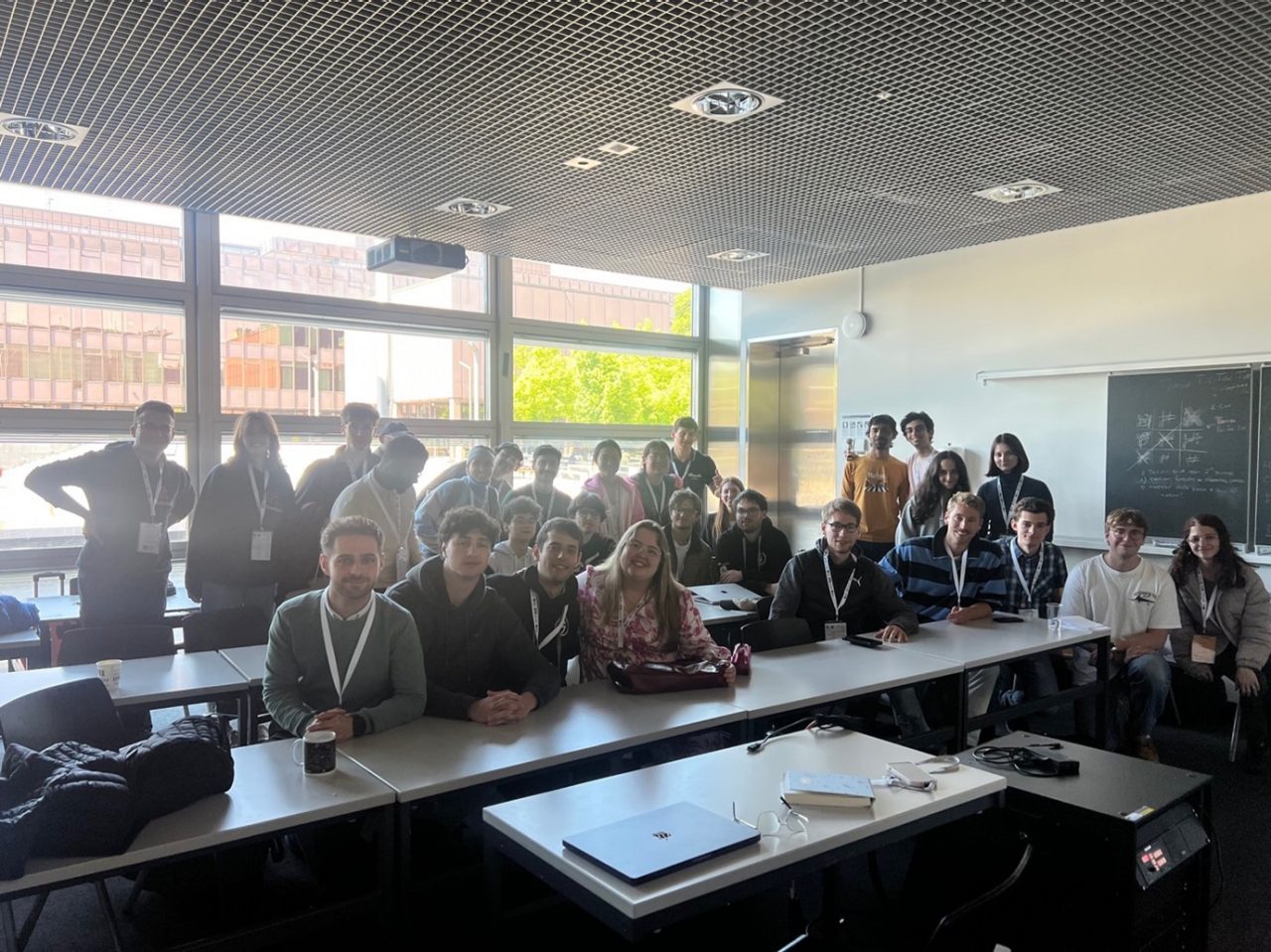
Group picture at ETH Zurich campus
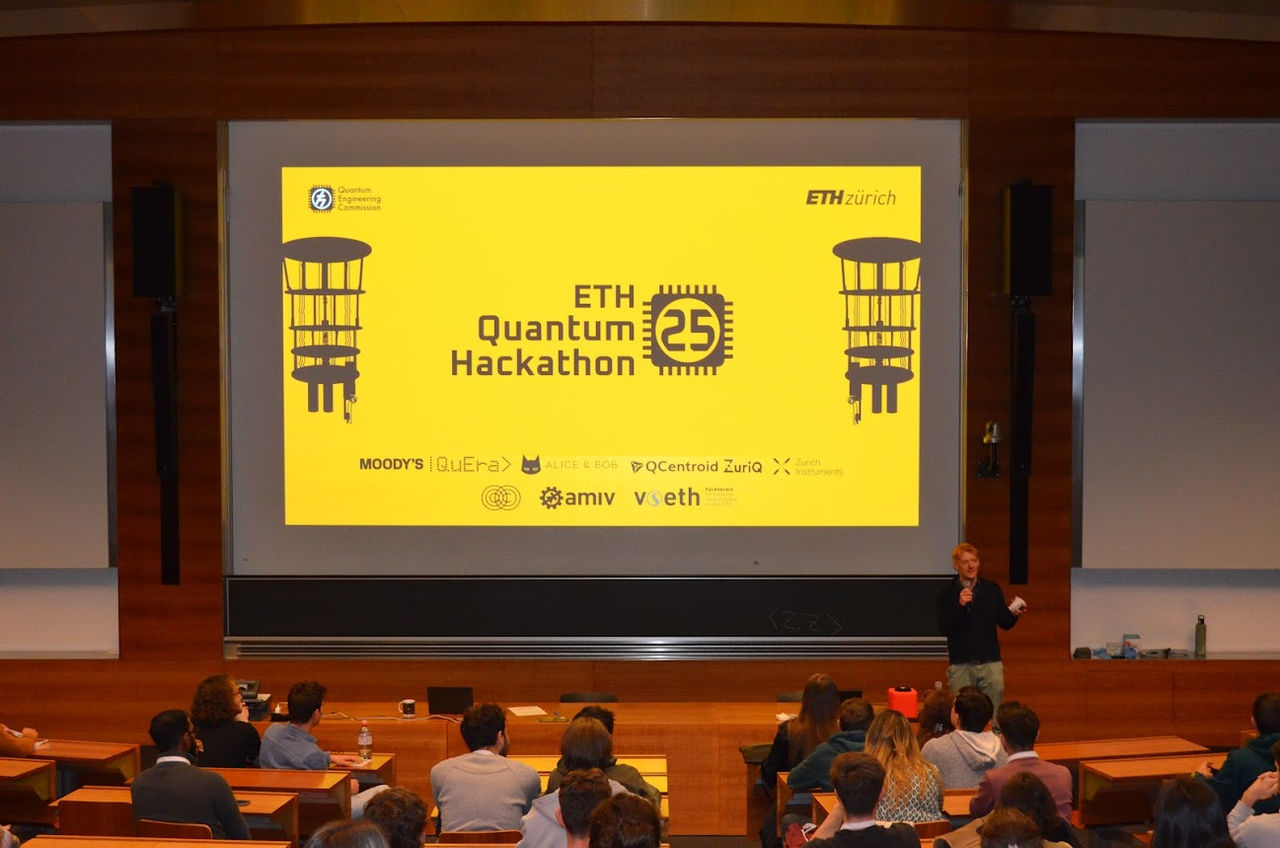
Professor Jonathan Home delivered the keynote address at the ETH Zurich Hackathon. He leads the Trapped Ion Quantum Information Group at ETH Zurich. His group focuses on research involving trapped ions for quantum computation, quantum simulation, and studies of quantum systems.
Moody’s challenge
In finance, a notable application involves using Quantum Amplitude Estimation to speed up Monte Carlo (MC) computations, commonly known as Quantum Monte Carlo (QMC). MC methods are extensively utilized to solve problems involving uncertainty, random processes, or high-dimensional integrals. Due to their versatility, MC methods are crucial in both theoretical and applied research across various disciplines. Despite their power, classical MC methods face limitations in computational efficiency, especially with high-dimensional problems. QMC offers a quadratic speedup over classical MC methods, potentially revolutionizing computational performance in financial modeling.
However, this theoretical speedup has recently been questioned. The concern is that the speedup is typically measured in terms of query complexity rather than overall computational complexity, and these are not necessarily equivalent. Querying a quantum computer involves significant overheads absent in classical computations, such as state preparation and error correction. Considering these additional operations, the actual computational advantage may be significantly reduced or even negated.
A significant bottleneck in QMC methods is state preparation, specifically the probability loading problem, which involves translating probability distributions into quantum states. This task is particularly challenging due to its poor scalability and the complexity of its computational steps. The Grover-Rudolph method, which is commonly used for this purpose, requires a series of computational steps that become increasingly complex as the precision of the state preparation improves. This preparation process is not only time-consuming but also prone to errors, often undermining QMC’s claimed advantages.
Various approaches can be found in the literature to address this problem, and the aim of our challenge was to explore how to efficiently encode probability distributions into quantum circuits. Students participating in the challenge were expected to delve into the following topics:
Understanding the complexity of loading probability distributions into quantum circuits
- Why is this step important?
- Which algorithms depend on this step being performed efficiently?
- What happens if we cannot efficiently load probability distributions into quantum circuits? Which algorithms would lose their advantage and which applications would fail to benefit from quantum computing?
Identifying bottlenecks and overcoming challenges
- What are the main obstacles to efficiently implementing probability distributions in quantum circuits?
- What proposals exist in the literature to address these challenges?
- Are there any fundamental limitations that make this process infeasible?
Learning encoding techniques
- How can we encode a probability distribution using methods such as tensor networks (TNs) and quantum Generative Adversarial Networks (qGANs)?
Performing resource estimation
- What resources are required to effectively implement these methods?
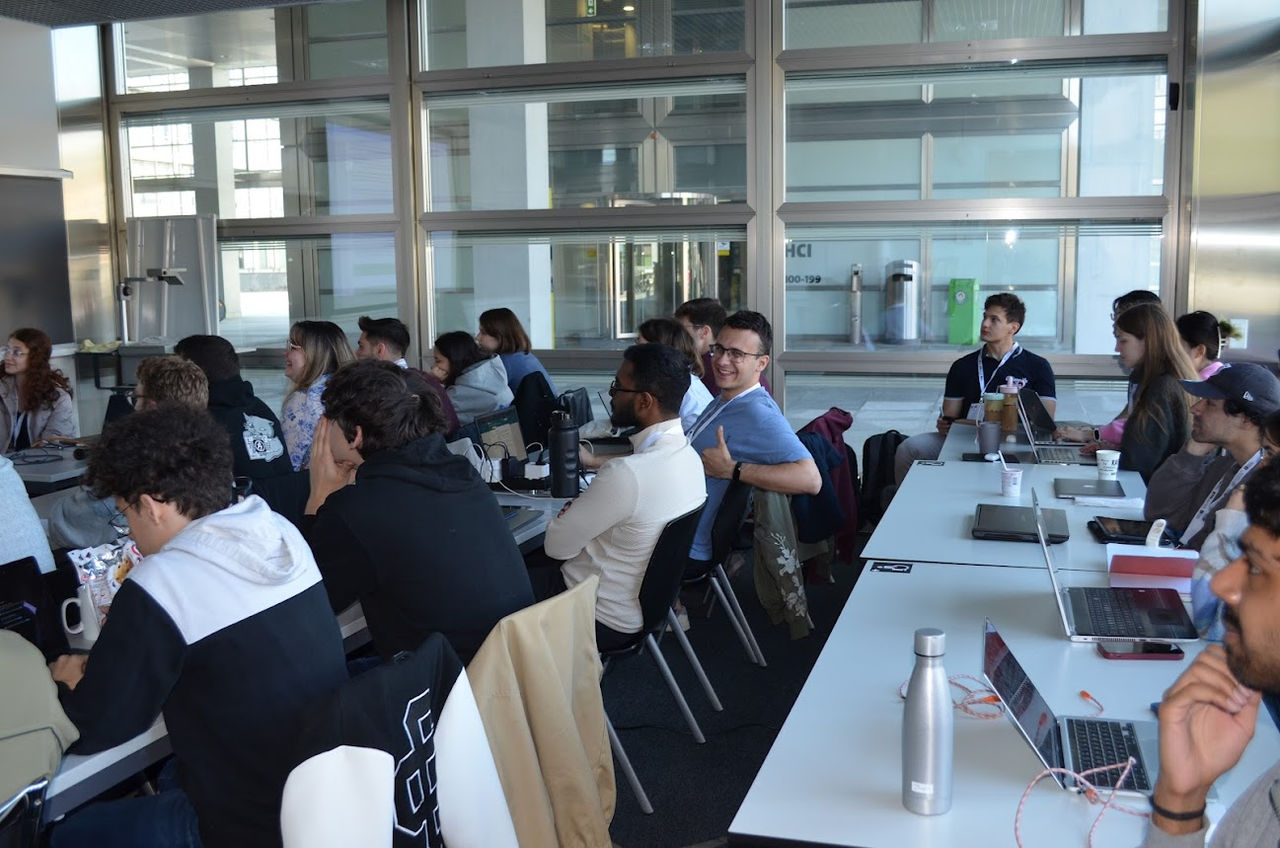
Workshop on Saturday — seven teams of four students participated in Moody’s challenge
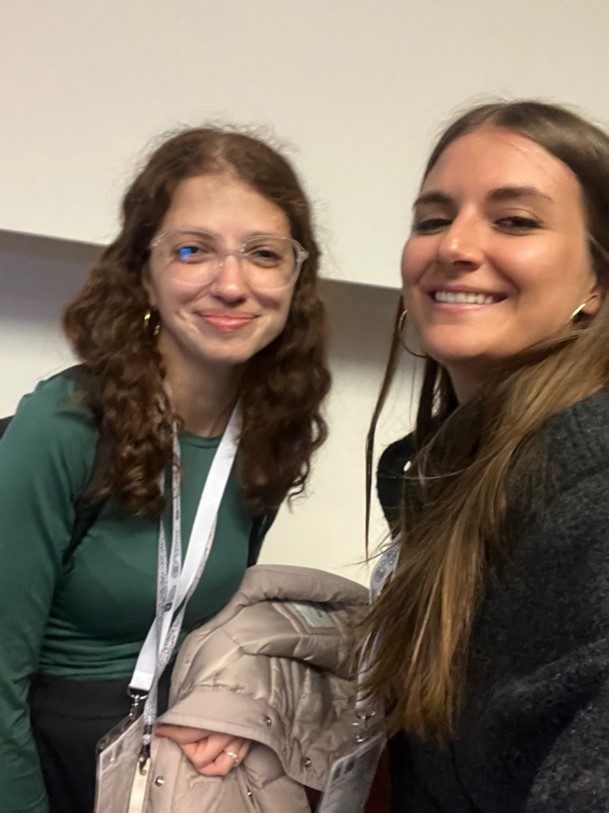
Mentors Irene and Carmen from Moody’s
The event
The three-day event — sponsored by QuEra Computing, ZuriQ, QCentroid, Alice&Bob, and Moody's — began on Friday with an introduction to each company and the challenges overview. Teams were formed, and the evening ended with pizza and networking.
On Saturday, the problem statement and tools were presented before the challenges were revealed at 10:30 a.m., kicking off the hacking competition. Students worked tirelessly at ETH Zurich’s Hönggerberg campus, with many teams pulling an all-nighter.
Sunday saw teams wrap up their projects and present to the judges. Seven teams, comprising 28 students from diverse backgrounds, tackled Moody’s challenge, applying quantum algorithms to real-world problems. The winners will present their work to Moody’s quants, and the results will be published as a white paper.
Winning teams and quotes
All the students who participated in our challenge displayed remarkable enthusiasm for learning about tensor networks. They were actively engaged, consistently working and asking insightful questions. We were truly impressed by their dedication and effort throughout the event.
The winning team, “No Qlue,” stood out with its exceptional creativity. Not only did the team members complete the challenge with high-quality results, but they also took the initiative to explore additional research ideas for enhancing their outcomes, differentiating them from the rest of the participants.
The team “GOATS” secured second place, impressing us with its deep understanding of tensor networks, the quality of its solution, the clarity of its result visualizations and the way its members collaborated.
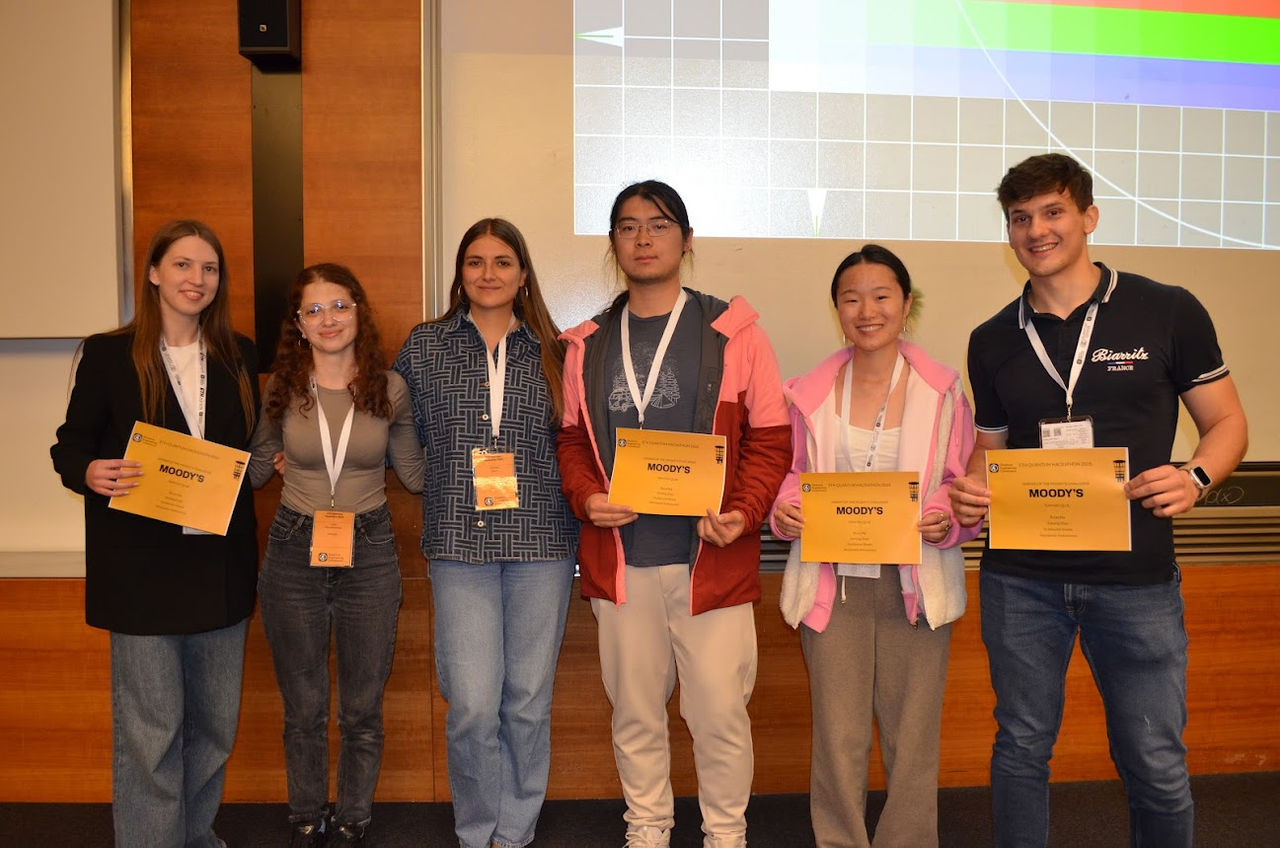
Winning team “No Qlue” and Moody’s quantum team; from left to right: Yelyzaveta Vodovozova (Technical University of Munich), Irene Papaefstathiou and Carmen Recio (Moody’s), Ruize Ma and Xuheng Zhao (ETH Zurich), and Guillaume Slowik (Politecnico di Milano)
The winning team said:
From the start, our team was excited by the challenge of loading probability distributions into quantum states using tensor networks not only because of its technical depth but also due to its many applications in quantum computing and machine learning. Working with TT-cross to encode 1D, 2D, and 4D distributions was already a meaningful task, but what truly sparked our curiosity was the quantization aspect. Inspired by the provided research paper, we explored different ways of switching tensor positions within the network and decided to go further. By leveraging knowledge of parameter correlations, we experimented with index positioning to improve the approximation accuracy of our tensor trains.
The creative freedom and constant support from the organizers kept us going, even when the path forward wasn’t clear. Seeing the diverse approaches from other teams was equally inspiring and gave us new perspectives. This hackathon wasn’t just about solving a problem — it was about discovering how many more questions we can still ask.
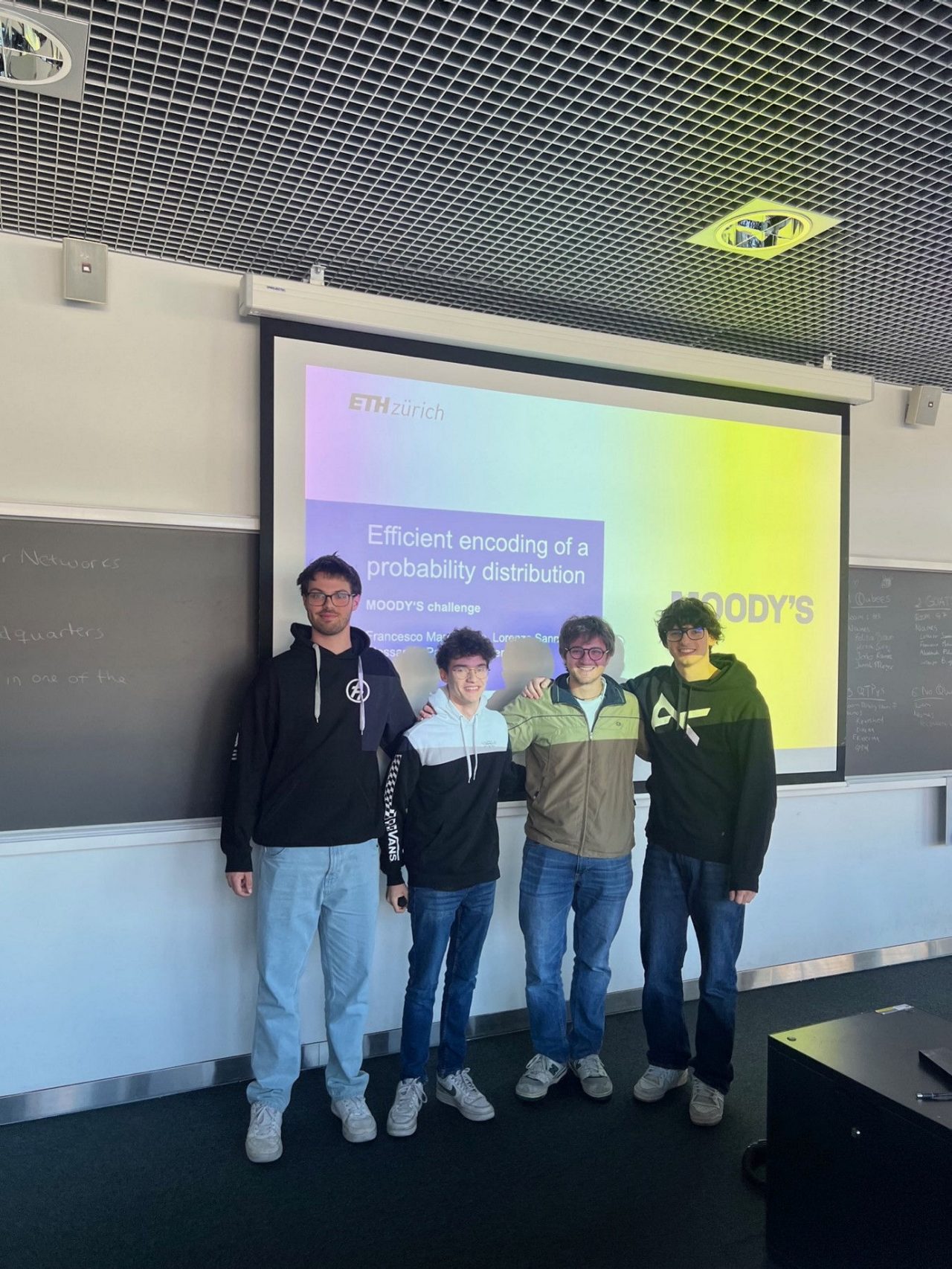
Honorable mention to team “GOATS”; from left to right: Francesco Marcolongo, Lorenzo Biagi, Lorenzo Sannino, and Alessandro Palumbo (ETH Zurich).
According to team “GOATS”:
This hackathon experience was particularly intriguing for us as we were able to convert our limited knowledge on tensor networks to a deep theoretical understanding of the proposed topic. Moreover, the hands‑on guidance and feedback from industry experts and our peers enriched our approach, allowing us to refine our models with practical insights and meaningful advice. The challenge allowed us to seamlessly merge our analytical knowledge with the development of a structured and conformable framework, laying the foundations for multiple applications in quantum simulations and finance. Collaborating with a top‑tier company in such a dynamic and prestigious setting ignited our motivation for pursuing further research, empowering us to leverage the expertise we gained throughout this project.
Wrapping up and what is next
The ETH Quantum Hackathon was a fantastic opportunity to identify talent, collaborate on problems of interest, and connect with brilliant minds.
For the technical audience, stay tuned — our problem statement and the winning team’s results will be published as a white paper in the coming months. Hackathons like this are invaluable for driving innovation on business-relevant challenges and engaging with top talent from leading institutions.
At the end of the event, winners from each challenge (Moody’s, QuEra’s, and so on) presented their work to all participants, who voted for the best presentation. We’re thrilled that our students took home the overall prize! Keep calm and hack on!
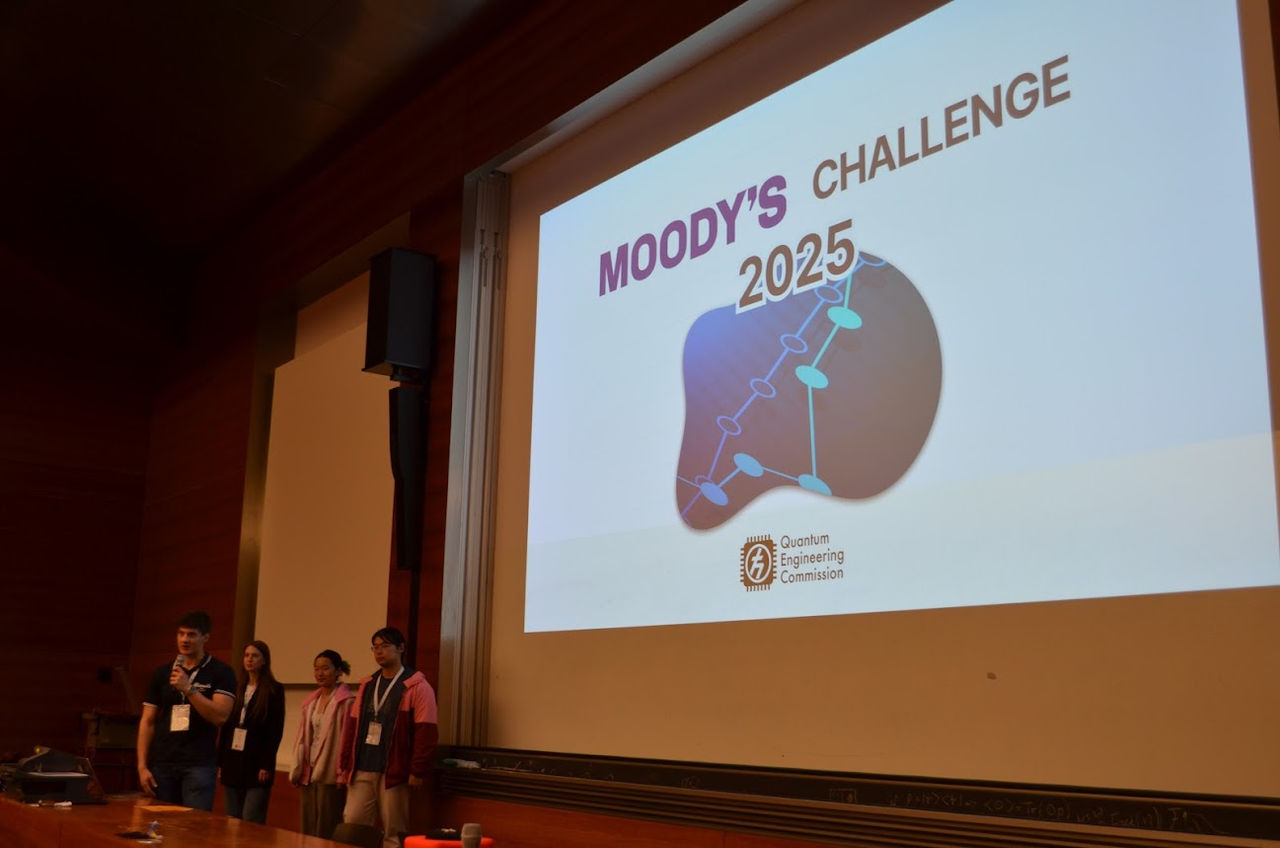
Winning team “No Qlue” presenting its solution in the auditorium in front of all hackathon participants, organizers, and sponsors
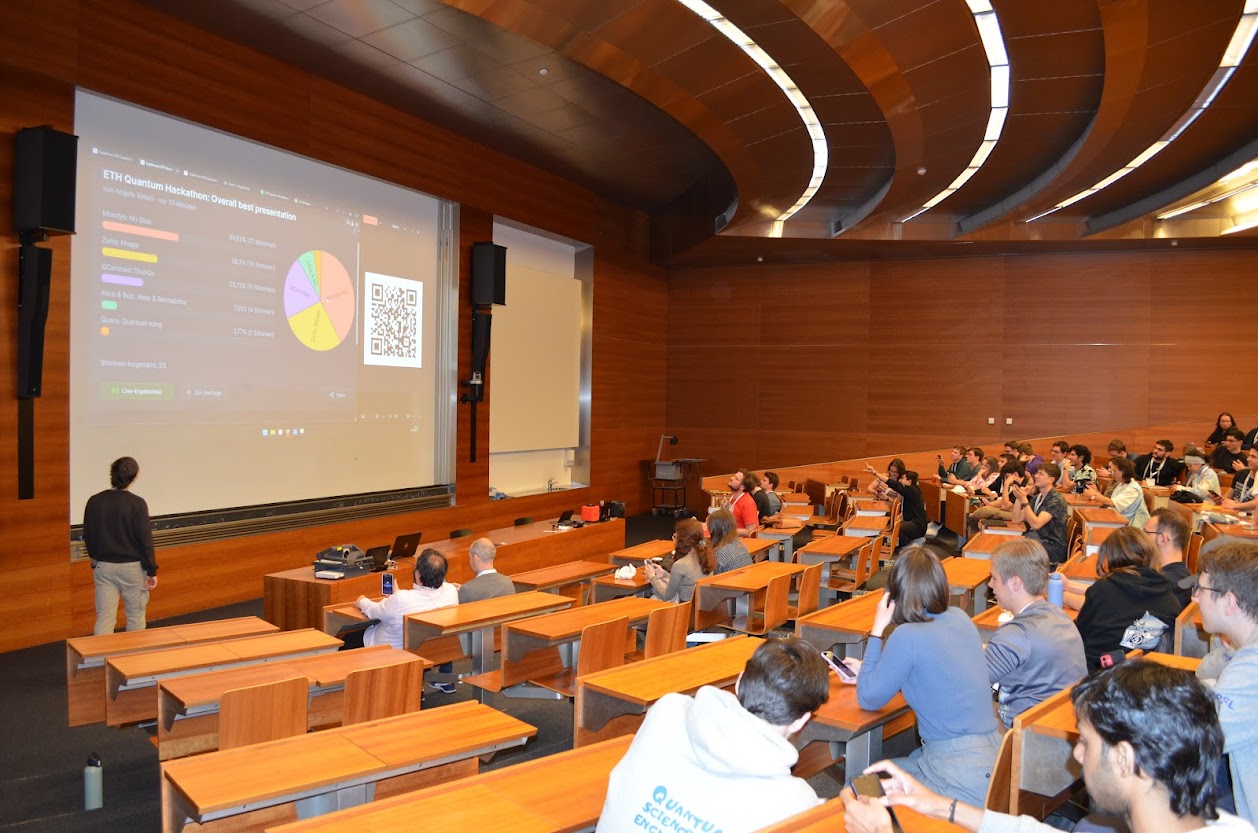
The Moody’s challenge winning team, “No Qlue,” was chosen as best presentation.
Moody's Challenge
You can see the challenge statement here.
Get in touch
Speak to our team
Let’s discuss your needs and how we can support you.