
In an era where data is both a strategic asset and poses a myriad of compliance challenges, organizations are re-evaluating their data management and connectivity strategies to navigate these dual roles effectively.
Traditional master data management (MDM) solutions have long played a critical role in establishing a centralized, standardized ‘single source of truth.’ While foundational, these systems can be resource-intensive to implement and maintain, and may introduce a few considerations in today’s evolving data environments. Enter the keyring approach—a modern, flexible alternative that’s quietly reshaping how enterprises think about data interoperability. By focusing on effective data linking without requiring full integration, the keyring strategy complements traditional MDM approaches—offering a flexible way to unify data while preserving existing infrastructure. Moreover, it enables organizations to benefit from using multiple data providers for global entity reference data.
What is the keyring approach?
At its core, the keyring approach is unified data access without full integration. Rather than centralizing data, it uses unique identifiers—or “keys”—to link customer and counterparty data across disparate systems. This allows organizations to create a single, actionable view of a customer or entity without physically moving or standardizing the underlying data.
The keyring approach acts as a dynamic facilitator among various systems, creating an integrated network without necessitating the physical unification of data. This "virtual handshake" facilitates seamless interaction and interoperability, ensuring that systems such as Customer Relationship Management (CRM), Enterprise Resource Planning (ERP), and MDM, along with external identifiers, function collaboratively while retaining their unique roles and configurations. Consequently, organizations can maintain their existing infrastructures, avoiding the disruption and costs associated with centralizing data repositories. Moreover, by serving as the connective tissue, the keyring brings diverse data sources into a coherent framework, thereby enhancing the visibility and utility of information available to decision-makers. This strategic connectivity not only streamlines operational workflows but also expedites access to actionable insights, empowering enterprises to respond swiftly to evolving market demands and uncertainty within the compliance landscape.

Keyring versus MDM: a strategic shift
While MDM centralizes and standardizes data, the keyring approach links data across silos. This distinction is more than technical—it’s strategic. Keyring offers a faster, more cost-effective path to data unification, especially for organizations wary of the compliance and operational risks associated with large-scale data centralization.
Where MDM can be time and resource-intensive, keyring is lightweight and privacy-conscious. It keeps data in its original location, reducing exposure and aligning more naturally with modern data governance frameworks.
Why it matters
For global banks and multi-national corporates, the keyring approach is particularly compelling. These organizations operate across multiple jurisdictions, regulatory regimes, and business lines. A unified counterparty view is essential — and so is flexibility.
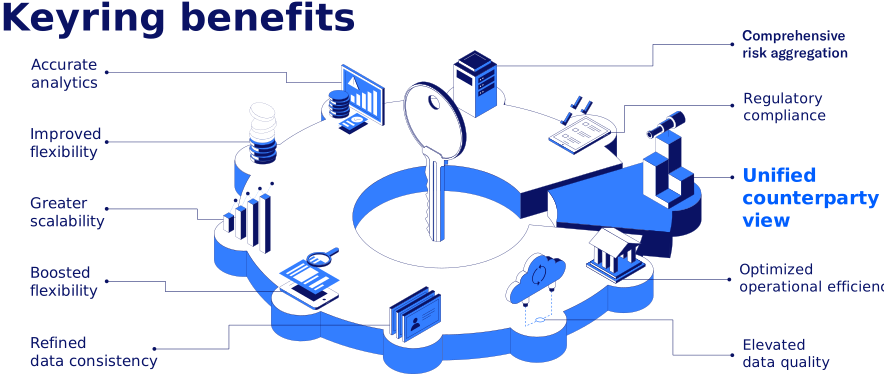
By linking internal and external identifiers at the counterparty level, keyring enables:
- Improved operational efficiency
- Faster decision-making
- More accurate analytics
- Comprehensive risk aggregation
- Stronger regulatory compliance
It’s not just about better data — it’s about better decisions and outcomes.
So why isn’t everyone doing this?
Despite its advantages, keyring adoption has been slow across industries. Why? A mix of legacy infrastructure, organizational inertia, and perceived lack of return on investment (ROI). Many teams are still incentivized based on unit-level performance, making cross-functional data initiatives a tough sell. And because keyring is often seen as “back-office infrastructure,” it struggles to compete for resources against more visible, revenue-generating projects.
However, as data privacy regulations tighten and the need for real-time cross-system insights grows, the case for keyring is becoming harder to ignore.
Looking ahead: futureproofing with keyring
The keyring approach isn’t just a workaround—it’s a future-proof strategy. It supports various use cases across data virtualization, aligns with modern security protocols, and enables smarter vendor selection. For organizations looking to modernize without overhauling, it offers a pragmatic path forward. In a world where agility, compliance, and insight are non-negotiable, keyring may just be the key to unlocking your data’s full potential.
Unify your data. Amplify your impact.
Get in touch
Company reference data
Moody’s is a leading global provider of data and analytical solutions designed to help your company gain insight, drive efficiency, and make risk assessment decisions with confidence.