
Shifts in US–Canadian tariff policies in 2025 have affected Canadian businesses and catalyzed a need for trade diversification.
For decades, the United States has been Canada’s top export market. This has been supported by geographic proximity, the 1965 Canada–United States Automotive Products Agreement, broad free trade agreements beginning in 1988, and the US’s position as the largest national market globally. However, in 2025, this trade partnership faced significant challenges with the introduction of steep, sweeping tariffs. These changes have prompted renewed discussions about the need for Canadian trade diversification.
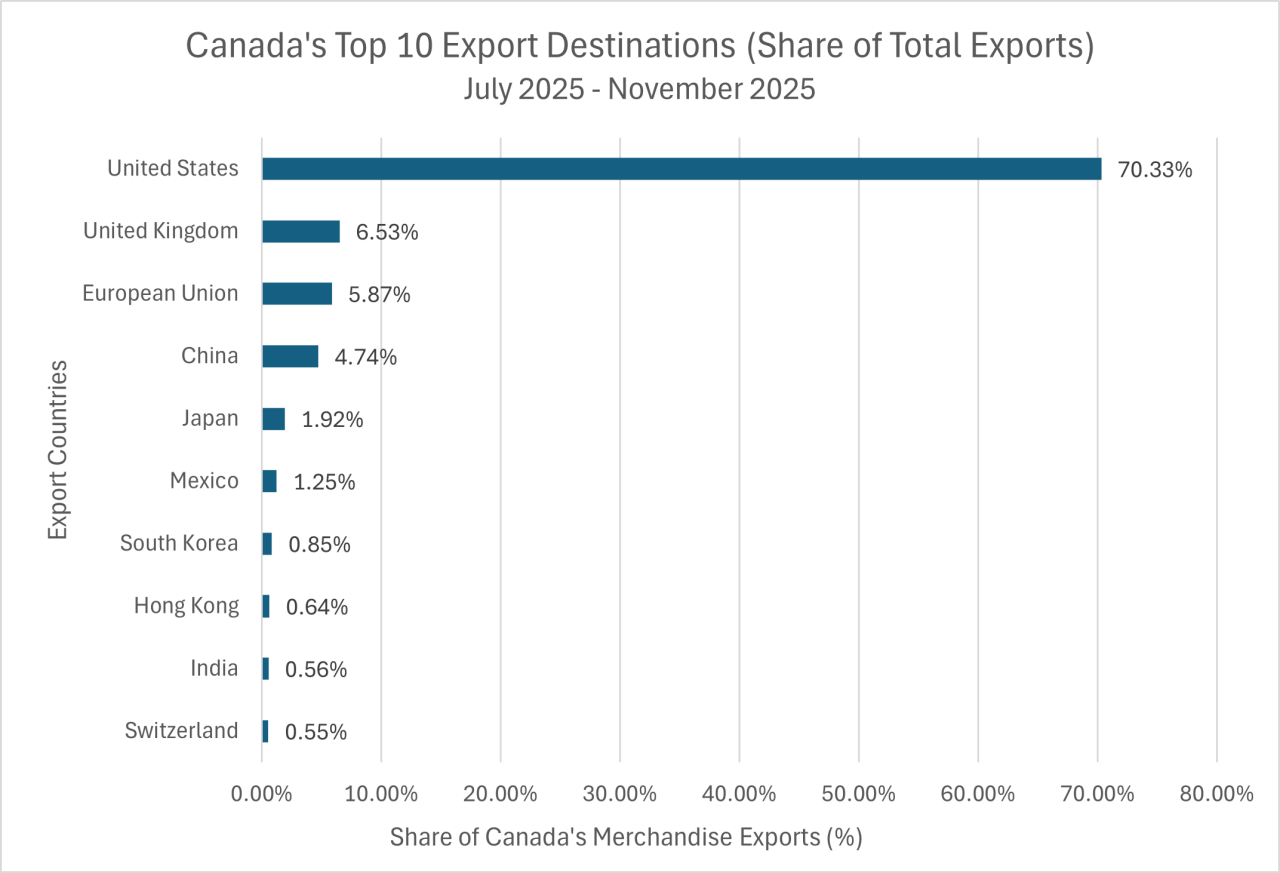
From July-November 2025, after the implementation of tariffs, 70% percent of Canadian exports were still sent to the US
Source: Statistics Canada
Import tariffs between the US and Canada in 2025
Starting in March 2025, Canada faced 25% tariffs on nearly all goods imported to the US, excluding those covered under the Canada-United States-Mexico Agreement (CUSMA). Canada shortly after imposed counter tariffs of 25%. In August, US tariffs increased to 35%, with the US citing concerns over illicit drugs flows. The US levied global sectoral tariffs that override previous free trade agreements—copper, steel, and aluminum rose to 50% and softwood lumber to 10%—along with anti-dumping and countervailing duties. While the US Supreme Court has struck down the fentanyl-based tariffs, the sectoral tariffs remain. These tariffs, combined with the stress of recently eased tariffs from China on canola products, pork, and seafood, have negatively impacted Canadian businesses and increased economic uncertainty.
To reduce the risk of overreliance on one foreign trading partner, Prime Minister Mark Carney announced in October 2025 a pledge to double its non-US exports in the next decade.
Hurdles for trade diversification
While Canada has free trade agreements with 51 other countries including Mexico, the ease of trading with the US—bolstered by CUSMA and supported by well-established systems and infrastructure—has dissuaded some Canadian exporters from pursuing other markets. Expanding heavily beyond the US can present logistical, legal, cultural, and reputational hurdles.
Logistical challenges
Perhaps the most immediate hurdle is the increased shipping distance to non-US markets. Longer transit routes can significantly raise shipping and packaging costs as goods travel through additional handlers, modes of transportation, varied terrain, and temperature changes. These conditions may require introducing new, reliable shipping partners into the supply chain. Insufficient vetting of downstream partners can increase the risk of shipment failures, bottlenecks, or other disruptions.
Legal and regulatory requirements
Diversifying trade also introduces a new set of legal requirements per country. These may include proper documentation—like commercial invoices, air waybills, bill of ladings, certificates of origin, export licenses, and environmental impact assessments—and accurate payment of customs duties and tariffs. Language barriers may require translation services to ensure documentation is accurate and compliant. Failure to meet such requirements could result in fines, penalties, or delays.
Reputational risks
Buyers in new markets, particularly those with established consumer advocacy, may desire stronger proof that Canadian businesses adhere to rigorous environmental standards and fair labor practices. The increased scrutiny may also come from media outlets in target markets, which may investigate and report on a business’s claims. Loss of trust by multinational consumers could lead to boycotts or loss of contracts with wholesalers or retailers.
Corruption risks
Trading with emerging markets may involve higher corruption risk, especially in jurisdictions with fewer regulations or weaker enforcement. For example, corrupt partners may divert goods to sanctioned markets through unauthorized re-exports. Or, customs brokers may bribe public officials to falsify import documentation, expedite or overlook required inspections, and skirt import duties. This can put businesses at risk of breaching Canadian anti-corruption laws that apply Canadian business operations abroad.
Solutions to help Canadians diversify trade
Despite these barriers to growing Canadian trade diversification, there are readily available solutions that may reduce operational, regulatory, and reputational risk.
Supply chain partner vetting
To minimize the risk of potential shipping delays or failures, exporters should thoroughly vet shipping and downstream supply chain partners. While traditional vetting methods like referrals, internet reviews, and in-person consultations can offer some assurance, this information may be incomplete. Businesses may have unseen risks like poor financial stability, poor operational resilience during severe weather conditions, or regulatory non-compliance. Data-driven supply chain vetting tools can provide exporters with impartial, evidence-based insights into individual companies or hundreds filtered on specific criteria. Data on supplier performance risk, physical risk, and legal compliance are tools for exporters to achieve greater confidence when expanding supply chains.
Legal and ownership transparency
To address potential legal risks that may arise from working with shipping or retail partners, business intelligence tools can help assess company identity and ownership structures by mapping corporate structures and beneficial ownership. This can help exporters reveal potential links or influence from politically exposed persons, sanctioned entities, or other risky entities. These links, in turn, can help organizations identify indicators of potential fraud or corruption risk, enabling better decision-making.
Environmental and labor compliance
To maintain trust and transparency with customers in foreign markets, exporters can use business intelligence tools that provide insights into environmental and forced labor risks. This supports compliance efforts and market-specific buyer expectations of corporate due diligence.
Moody’s tools for the trade diversification
Shifts in US–Canadian tariff policies have affected Canadian businesses and catalyzed a need for trade diversification. Despite potential growth opportunities for Canada’s natural resources, agricultural products, technology, and merchandise in emerging markets and those with expanding middle classes, Canada has been slow to diversify markets. Establishing new trade systems comes with new shipping, legal, and cultural requirements, which requires thoughtful planning and resourcing.
Building a trusted network of supply chain partners may be one of the strongest ways that export businesses can overcome trade barriers and expand their businesses abroad. To find reliable suppliers, carriers, and customers, exporters can use business intelligence data to efficiently and comprehensively vet potential partners. Moody’s global data sets and analytics on over 600 million companies can help businesses, government trade commissioners, and export promotion offices gain insights into potential operational, regulatory, and reputational risks, providing exporters with the tools to navigate the complexities of new markets with greater confidence.
To access tools that can support public and private economic development, please do not hesitate to get in touch.
Learn more
Moody's credit risk solutions
With more than a century of expertise in risk combined with market-leading research and cutting-edge technology, we provide extensive data, actionable insights, and robust analytics to navigate uncertainty, strengthen your credit risk assessment and unlock the opportunities.