Helping our people grow their skills for today and tomorrow is a priority, so we provide training and development opportunities throughout their careers. Whether it's job-specific knowledge, leadership capabilities, or core skills, we're focused on continuous learning and building up our talent.


Moody's University provides employees with ongoing learning and development opportunities. It accommodates various learner needs with a dedicated training app and a diverse range of learning modalities, such as videos, books, audiobooks, and live events. With over 50,000 training courses available, employees can leverage Skill IQ assessments to identify knowledge gaps and find role-aligned learning pathways, organized learning channels, and hands-on labs for practice. We also partner with universities and other world-class organizations to provide employees with access to certification prep centers.

A strong leadership pipeline is paramount to our continued success. We grow leaders who model our values and embody our Employee Value Proposition: to unite the brightest minds to turn today’s risks into tomorrow’s opportunities.

To provide a forum on the company’s GenAI journey, we implemented the Expo AI webinar series. Through these sessions, leaders across Moody’s share insights on our GenAI roadmap, use cases and product development.
Moody's employees also have access to a diverse range of Generative AI (GenAI) training through the Moody's University platform where they can assess their proficiency in Artificial Intelligence (AI) and Machine Learning (ML). Based on the assessment results, the platform recommends tailored training programs to enhance their skills in these areas.

We partner with Cornell University to offer the Cornell Sustainable Innovation Program, a five-month course developed to foster entrepreneurial thinking in mid-level managers. The program comprises live sessions led by Cornell faculty and online courses. Participants from across Moody's complete the program and receive a certificate of completion.
We hold an annual Global Hackathon, where employees collaborate to generate innovative ideas aimed at enhancing impact across Moody's. Winning projects span many topics within one of our three categories: integrated risk, social impact, and customer centricity.

We provide comprehensive upskilling programs to enhance our employees’ capabilities across various domains. These initiatives encompass competency mapping, learning paths, SaaS operationalization, mandatory analyst training, and cutting-edge topics such as blockchain, cyber risk and decentralized finance.
We deliver comprehensive credit training for our analyst community through a range of programs, including Analyst Training & Certification and the Credit Masterclass. These programs mix instructor-led training, self-study, and certification – focusing on core credit knowledge, asset class expertise, digital finance, and other innovation areas.
Moody’s University launched the "Certified Adjunct Program," a peer-to-peer learning model that enables adjunct facilitators within business units to provide effective soft skills training to their peers.
Learning materials
Curated playlists with 4,000+ followers
1, 2, 3 Total training hours in 2024
Languages offered for learning courses
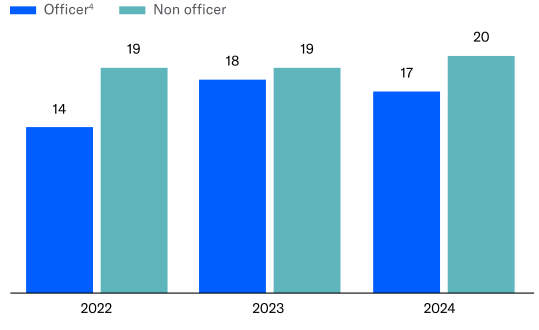
¹ The data represents approximately 30% of employees (excludes certain nonwholly owned subsidiaries and newly acquired companies not integrated in Moody's IT systems).
² Data includes hours captured in the Moody's University and centralized online training programs, related to completed training on topics such as compliance, professional development, among others. There are other training programs not captured in the scope of this metric, like professional certifications, on-the-job learning, and other learning events not administered through Moody's University.
³ The training activity decreased in 2022 due to a continued move to online training, including a focus on shorter training duration.
⁴ Officer-level data is calculated using the job categories: executives, senior managers, mid-level managers and first-level managers.
