

We routinely dive deep into Moody's Analytics Grid database to understand the significant trends across all types of financial crime. We share what we learn here, with our clients, and the broader AML/KYC/S community. For insights on trends – such as those shared in this post – we combine external research with aggregated analysis on the events reported as human trafficking-related by regulatory lists and adverse media. For more information or a demo of Grid, contact us.
More corporations are being held accountable for modern slavery, human trafficking, and forced labor in their supply chain.
Our data shows that reported prosecutions against organizations for modern slavery have risen, signifying a shift in attitudes and regulations toward auditing supply chains for modern slavery violations.
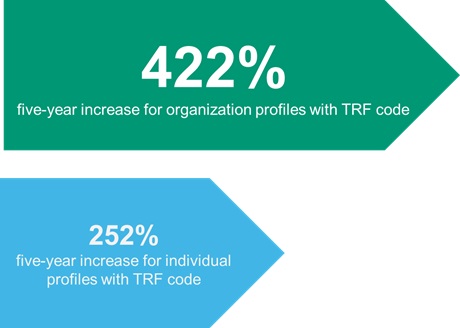
Media coverage of modern slavery is affected by tragedies, which create a public response. Tragedies generally raise public awareness and promote a push for governments to enact legislation and agencies to enforce it. Enforcement, in turn, influences media coverage. Governments take a proactive approach when they introduce regulation, aiming to prevent modern slavery. Implementing regulations and legislation can:
And regulations can affect Grid profile events in two ways:
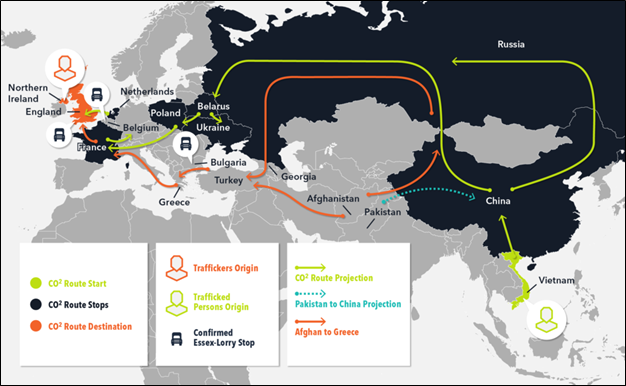
The CO2 route (highlighted below) is a common migrant trafficking route carried by refrigerated shipping containers with little oxygen, is a life-threatening 6,000-mile journey across Asia into Europe, with the UK as the intended destination.
In the Essex-Lorry case, the truck was confirmed to have stopped in Varna, Bulgaria, before traveling by ferry from Zeebrugge, Belgium to Purfleet, Essex; then discovered in nearby Grays.
In 2019, 39 Vietnamese migrants were found dead in the back of a semi-truck in England. As the story made international news and the route was made public, it brought attention to those particular smuggling methods. And one month later, 41 Afghani migrants were found in a similar lorry in Greece, having traveled through Turkey.
In 2018, Pakistan passed the Prevention of Trafficking in Persons Act, allowing that nation's authorities to prosecute human traffickers for the first time in over 10 years. With subsequent enhancements in monitoring and enforcement, the authorities recognized a trend in bride trafficking of Pakistani women sold to Chinese men through marriage brokers. This awareness and ensuing crack down on those practices showed up in Grid in 2019, when it captured the highest rate of marriage-based trafficking events from Pakistan - an increase of 1000% over the prior year.
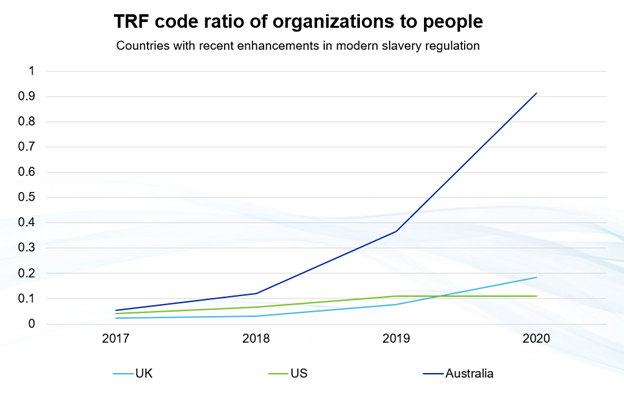
With the implementation of Australia’s Modern Slavery Act of 2018, Oceania has outpaced many other regions in recognizing the role companies can play in identifying, tracking, and combating human trafficking as part of their KYC/KYS due diligence programs. The US and UK have strong programs, with the UK Modern Slavery Act of 2015 and the US Global Magnitsky Sanctions, but according to published litigations, these countries are not yet at the same pace of recognizing the institutional aspects of forced labor and human trafficking. As seen in the graph, the ratio of organizations to people with Grid profiles that include the TRF code is close to 1 - a powerful metric considering the population of individuals vs possible number of companies in the world.
According to the Finance Against Slavery and Trafficking (FAST) initiative, when regulators include questions on the presence of human trafficking indicators, reporting increases by 1,000% — which suggests significant under-reporting.
Lack of visibility and being ‘disconnected’ keep human trafficking a hidden, under-reported crime. Other factors may include:
Whether trends are driven by new legislation or better reporting - modern slavery-related events and risk-relevant information is compiled in Grid– our database of high-risk individuals and organizations. It includes over 14 million profiles, sanctions lists, daily ingested adverse media coverage and over 2 million PEPs. Inherent risks and offenses are tagged with one of 49 risk codes, including a code for human trafficking (TRF). In our database, TRF encompasses a multitude of offenses each part of the larger modern slavery typologies.
To learn about best practices in finding and eliminating modern slavery in the supply chain, read Modern Slavery: How to root it out of your supply chain.
The goal of compliance is not to detect money laundering, but to find underlying criminal industries, such as modern slavery, that perpetuate illicit financial flows. You can adopt this approach at scale while maintaining operational efficiencies by using our best-in-class features:
If you have any questions about MA’s solutions or would like to discuss KYC for your business, use our contact form.