What is Moody's Shell Company Indicator?

Shell companies are sometimes used to obscure illicit activity and the proceeds associated with it. Reviewing corporate structures and ownership patterns for potential shell company risk can be complex and time-intensive.


Moody’s Shell Company Indicator supports customer and third-party onboarding and investigative workflows by applying typology-based indicators designed to help identify risky corporate behaviors that may warrant closer review. These indicators can be used as part of broader risk assessment and due diligence processes to help inform decision‑making.




CNBC interview on shell company risk with Ted Datta, Moody’s financial crime industry practice lead.


7 potential indicators of shell company risk


Which characteristics may be associated with shell company risk?


Moody's has identified a set of corporate behaviors that, when reviewed in context, may be associated with elevated shell company risk across a third-party network. These characteristics are intended to support risk assessment and review processes and can be considered alongside other relevant information.


Directorships
Directorship patterns

Observed potential outlier patterns related to current or former directorships, including unusually high counts or repeated associations with inactive entities.

Mass registration
Mass registration activity

Registration patterns that suggest bulk or concentrated entity formation, such as multiple companies sharing similar attributes within a narrow registration timeframe.

Jurisdictional risk disparity

Situations where the nationality or residency of a director or beneficial owner differs from the company’s place of incorporation, and at least one of the relevant jurisdictions is commonly associated with elevated financial crime risk indicators.


Circular ownership
Circular ownership structures

Ownership arrangements that display circular or self-referential relationships among entities.

Outlier age of key individuals
Incosistent age data for key individuals

Cases where the reported age of directors or beneficial owners appears inconsistent based on reported data.

Dormancy
Indicators of dormancy

Periods of prolonged inactivity, such as companies with extended dormant phases within their operating history.

Financial anomalies
Financial anomalies

Revenue levels that appear disproportionate based on available comparative indicators when compared with indicators such as employee count or reported business activity.


Shedding light on potential financial crime risks with Moody’s Shell Company Indicator

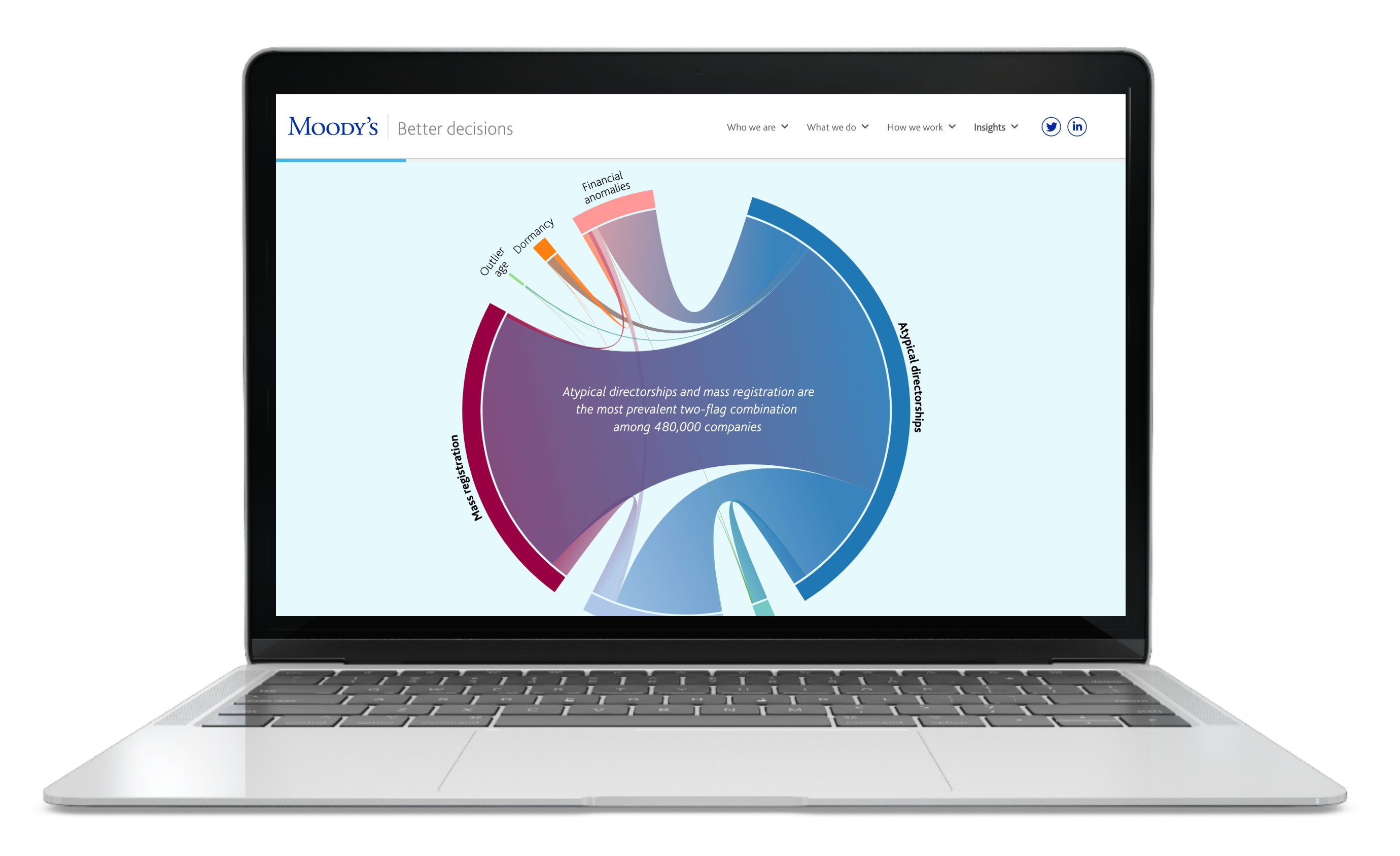
Risky business? A data story


Shell companies are sometimes used in connection with illicit activity, including money laundering linked to offenses like fraud, bribery and corruption, forced labor and exploitation, and illegal trafficking of people, drugs, wildlife, or other goods.


Within due diligence and investigative processes, Moody’s Shell Company Indicator applies defined indicators to highlight corporate behaviors that may be associated with elevated shell company risk, helping banks, corporations, and government teams determine where additional review may be appropriate.


Summary of the Shell Company Indicator solution

Key attributes of the Shell Company Indicator solution


Access insights derived from Moody’s database on millions of corporate entities, including information on corporate ownership structures and ultimate beneficial owners (UBOs). Indicator attributes are refreshed on a regular basis to reflect updates in the underlying data to support timely review and analysis.

Within the user interface, a summary view presents the indicators reviewed as part of the Shell Company Indicator analysis, displayed using a three-color framework intended to support prioritization. From the summary view, users can further explore underlying data, including directorship patterns, circular ownership structures, repeated registrations, and related attributes. 

The Shell Company Indicator solution can be incorporated into existing risk and review workflows, configured based on an organization’s internal processes. It supports the assessment of entities and individuals within third-party networks using indicators and contextual information that may assist in highlighting areas where additional review is warranted.


Business woman holding a tablet
Continuation of business woman holding a tablet


Surface potential risks related to shell companies

Mitigate financial crime risk
Support financial crime risk review

Apply shell company–related indicators across the lifecycle of a business relationship, including information that may be used to document review considerations and rationales when reassessing prospects, customers, or suppliers

Enrich due diligence processes
Add depth to due diligence processes

Examine indicators associated with circular ownership, atypical directorship patterns, repeated registrations, periods of dormancy, jurisdictional risk considerations, beneficial ownership structures, and financial anomalies as part of due diligence and investigative research.

Reduce workload
Help streamline research efforts

Access shell company–related indicators through a task based user interface designed to support structured review, helping teams focus research and investigation efforts.

Speed up onboarding and investigation
Support onboarding and investigative workflows

Within compliance or KYC workflows, shell company indicators can support review and understanding of entity level risk considerations, helping teams progress onboarding and investigations with greater consistency. 


How Moody’s can support sector-specific review

Shell Company Indicator for organizations across sectors


Corporations face ongoing exposure to financial crime risk, including fraud and other forms of illicit activity, across customers, suppliers, and third-party relationships. Organizations may be expected to consider sanctions exposure, politically exposed persons (PEPs), and supply chain related risks, including forced labor as part of broader risk management and due diligence practices.

As a result, investigation and risk teams regularly review counterparties within their networks to better understand ownership structures, control relationships, and other factors that may be relevant to risk considerations.

Moody’s Shell Company Indicator supports these efforts by applying a set of indicators related to ownership, control, and other corporate attributes. These indicators can be used as part of wider due diligence and risk management activities to help surface areas that may warrant closer review.

National governments and governmental agencies play a role in addressing financial crime and related threats, including money laundering and associated offenses. These activities can pose risks to economic integrity, public trust, and broader security interests.

Complex corporate structures, including shell companies, may be used to obscure ownership or activity in contexts such as procurement, licensing, or investigations. Understanding these structures can be an important input into public-sector review and investigative processes.

For banks and financial institutions (FIs), understanding risk across customer and counterparty portfolios is an ongoing process that spans onboarding, due diligence, and periodic review.

As a highly regulated sector, banks and financial institutions (FIs) can benefit from greater visibility into shell company-related risk indicators.

Shell companies may present heightened considerations for financial crime risk, particularly where ownership, control, or jurisdictional factors are complex or subject to change. Monitoring these factors over time can be an important part of broader KYC and financial crime prevention programs.

Moody’s Shell Company Indicator supports banking workflows by applying shell company–related indicators that reflect changes in material ownership or corporate patterns. These indicators can be used during due diligence investigations and ongoing review to help inform risk considerations and support internal escalation, documentation, and reporting processes, where appropriate.


Man looking at phone
Continuation of man smiling looking at his phone


Moody's on-demand webinar

Risky business? Addressing hidden shell company risk

Moody’s Industry Practice Lead, Rich Graham, discussed the findings of our research into shell company risk, which probed the constitution of nearly 500 million organizations to identify and define suspicious corporate behaviors. He explained how these risky behaviors are identified and can be categorized for use in investigations and due diligence.

Then our panel featuring Sam Dorshimer, Bureau of Economic and Business Affairs, US State Department; and Anila Haleem, Principal, Sanctions and Export Controls UK Finance; and host Choon Hong Chua, a Moody’s Industry Practice Lead, shared how new risk insights have practical application for anti-financial crime, sanctions compliance, and third-party risk management.

Listen to the playback, and if you have any questions, please get in touch.


Risk Reframed podcast

Risky business? The indicators of shell company risk


There are plenty of shell companies formed for legitimate reasons. However, as recently uncovered in a major case in Singapore where 3 billion SGD of assets were frozen, shell companies can also be used for more nefarious purposes. This risks are not always easy to spot, especially when relying on manual, time-invasive processes.

In this episode of Risk Reframed, host Alex Pillow welcomes Moody’s Product Manager, Kate Weymouth, and Head of the Financial Crime Practice Group for APAC and the Middle East, Choon Hong Chua to the discussion on:

  • Legitimate reasons for shell companies vs. illegitimate reasons
  • The seven primary indicators of shell company risk
  • A deeper look into the recent Singapore shell company scam
  • How Moody’s Shell Company Indicator automates traditionally manual and time-consuming processes with powerful data


Articles and insights

More reading and resources on shell companies


Shell companies, characterized by their lack of active business operations or significant assets, pose unique risks to organizations. While not intrinsically illegal themselves, these entities can potentially serve as veils for illegal activities, including sanctions evasion and money laundering, due to their often complex and opaque corporate structures.


Shell companies can be used by criminals to conceal offenses such as fraud, tax crime, money laundering, and sanctions evasion, all of which pose a threat to the global economy. Against this background, there are significant moves from governments and the private sector to create more corporate transparency.


New interactive research from Moody’s uncovers risky corporate structures that can be used to enable sanctions evasion, money laundering, fraud, and other financial crimes.


Award-winning solution

Moody’s Shell Company Indicator

Shell Company Detection – Category winner

For a second year, Moody’s was recognized for its industry-leading shell company detection capabilities


Get in touch

Request a demo

We would love to show you what Moody's can do! Get a demo or alternatively, keep reading to discover more about how Moody's can help you.