

The world of fraud is constantly evolving, and emerging reports suggest scammers are posing as law enforcement agents calling people at home, claiming they have been involved in committing a crime.
In a recent news story out of India, a retired banker was allegedly kept as a digital prisoner in his own home for 54 days. The banker was scared, isolated, and reportedly lost nearly ₹40 lakh (48,000 USD). The criminals, impersonating police officers, used psychological fear and intimidation to control him.
In this scenario, the person impersonating a law enforcement officer asks their target to prove their innocence to avoid immediate arrest. They claim the individual must remain on a video call, cut off contact with any other individual, and transfer money to a "secure" government account as part of the process.
Scammers operate globally, so a local fraud scheme has the potential to spread rapidly and go global. FBI data indicates that the groundwork for evolution of this scam is already being laid; data from its 2025 IC3 Report shows a convergence of two specific types of crime: Government Impersonation and Threats of Violence.
“Fraud can adapt quickly, often drawing on established tactics but combining them in new ways. Understanding how these patterns may be developed over time can support teams who need to make informed decisions about how to approach and mitigate financial crime risks.”
— Rich Graham, Industry Practice Lead at Moody’s.
Viewed separately, these data points are concerning, but when combined, it may be possible to identify elements that resemble a potential "digital arrest" scam model that could spread globally.
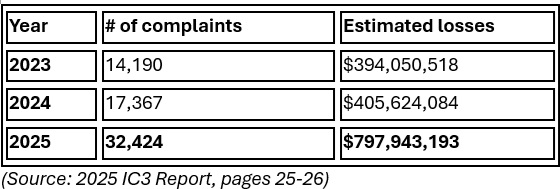
When reviewing year-on-year data from the 2025 FBI IC3 report, complaints and reported losses related to government impersonation increased significantly. And, if fraudsters have a number to call, they may have a potential victim to target, whether that number is in India, the UK, the US, or anywhere else in the world.
The authority of a badge is a powerful tool, and criminals are exploiting that, including over the phone or via video chat overseas. The data suggests that the number of complaints and financial damage related to government impersonation nearly doubled in a single year from 2024 to 2025.
Crimes involving threats of violence, which may begin online, can be used to create extreme fear in victims to extort cash. Both complaints and losses surged in 2025 in this area of fraud.
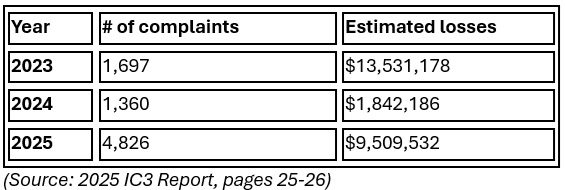
In 2025, Government Impersonation and Threats of Violence together reportedly accounted for 37,250 complaints filed with the FBI. While this represents approximately 3.7% of the 1 million+ total complaints reportedly received, their growth rate indicates a developing trend that may signal an area of increasing risk.
This kind of scam can create a powerful psychological impact, combining the fear of disobeying a police officer or federal agent with the perceived threat of imminent danger i.e., arrest or even harm to an individual or their family. This was the approach reportedly used on the retired banker in India. It combined multiple pressure tactics intended to heighten fear and decision-making stress.
The goal of these scams is to make people panic, which often impairs judgment. One defense is to be prepared, stay calm, and take time to think, as recommended by the UK “Take Five to Stop Fraud” campaign, led by UK Finance.
1. Law Enforcement's Rules of Engagement:
2. Adopt the AARP Mantra: Pause, Reflect, Protect.
3. The role of banks:
Financial institutions continue to train their tellers and fraud staff to spot potential red flags of customers under duress, i.e., those who seem panicked, are on the phone with a "handler," or are trying to move large sums of money for a strange reason. Banks are also trained to look for behavioral changes in accounts using a combination of internal and external data insights to help protect their customers.
The story of the Mumbai banker may act as a warning of what could become more widespread as different types of fraud continue to evolve and take hold.
Find out more about how Moody’s data, analytics, and workflow solutions can support financial institutions in responding to emerging fraud risks and strengthening anti-financial crime risk management approaches. Please get in touch any time.
*Disclaimer: This content is for informational purposes only and does not constitute legal, financial, compliance or other professional advice. Please consult with a qualified professional for specific legal, financial, compliance, or other professional advice. For more terms and conditions pertaining to Moody’s products and services, refer to the https://www.moodys.com/web/en/us/legal/global-disclaimer.html on Moody’s website.