

The scale and sophistication of modern fraud are significant. Organized criminal teams across the globe are blending the emotional manipulation of romance scams with the financial allure of investment schemes, stealing billions from victims year after year. This is underlined in an article shared by Interpol “According to the Global Anti-Scam Alliance, global losses from organized fraud and scams are estimated at USD 442 billion, underlining the scale and urgency of the problem.”
The latest FBI Internet Crime Complaint Center (IC3) report paints a concerning picture of adversaries that are agile, persistent, and operating on a global scale.
To better understand these schemes, it is first important to understand some of their methods, and that can start with following the money.
Rich Graham, an Industry Practice Lead at Moody’s, highlights, “the FBI’s 2025 IC3 Report sheds light on where funds stolen from scam victims are ultimately routed. In many cases, when criminals direct victims to send wire transfers, those funds move into specific jurisdictions.”
According to the 2025 FBI IC3 Report, the top 10 international destinations most frequently reported in complaints involving fraudulent wires include:
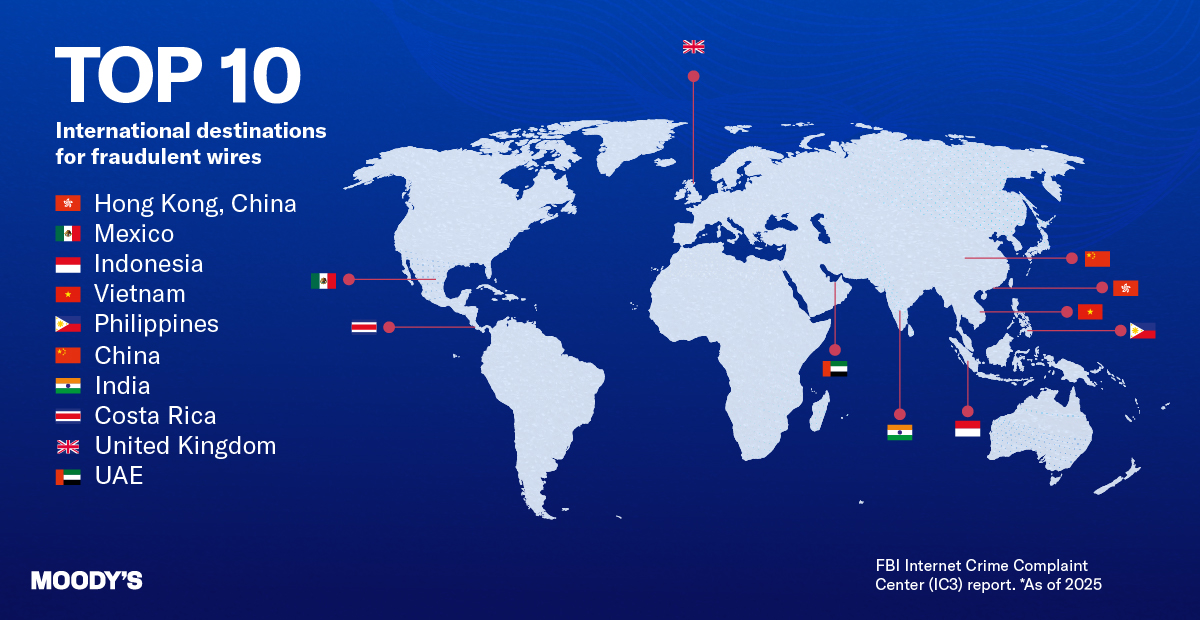
Comparing this to the 2024 data, it is possible to see how quickly criminal networks can pivot. While jurisdictions like Hong Kong, Mexico, and Vietnam remain frequently reported high-risk destinations, the emergence of Indonesia, Costa Rica, and the UAE into the top ten suggests that as one pathway closes, another may emerge.
To launder stolen money, criminals may leverage vehicles or entities that help them obscure connections and ownership and create the appearance of legitimacy. As the Financial Action Task Force (FATF) has noted, shell companies can act as the “getaway car,” potentially enabling criminals to move funds without detection.
This presents a major challenge for financial institutions. While discussions around sharing fraud intelligence between banks are ongoing, they are complicated by legitimate privacy concerns, which can slow down the development of coordinated risk-mitigation approaches.
But what if banks could look outward instead of inward? What if they could access a global dataset to better contextualize potential risks associated with an entity on the other side of a transaction?
Advanced analytics can help contextualize and identify risks. Orbis, Moody’s database of more than 625 million companies, has data on 19 million companies exhibiting one or more data indicators commonly associated with shell company characteristics.
These characteristics are established through identifying patterns like:
Combining multiple sources of risk-related data, for example the reported wire-routing patterns with Moody’s shell company indicator data, may help organizations apply greater scrutiny to some cross-border payments.
“The conversations I have with banks confirm that more needs to be done to help prevent fraud,” says Graham. “Investigators are deeply committed to helping the victims of scams, but there are times when those people being targeted by fraudsters are so emotionally invested, they may disregard the bank’s advice in order to get their money out and send it to the bad actor.”
In response to the powerful psychological hold scammers have over their victims, some banks are employing what’s known as "Break the Spell" teams. These are specialized units, sometimes including psychologists, who are trained to intervene and help a victim reconsider potentially suspicious situation. They aim to encourage victims of scams to question inconsistencies, so the victim doesn’t remain entrenched in the narrative that feels emotionally compelling but may not align with the facts.
This is where counterparty data can become a helpful tool for customer conversations. It can help trigger these “break the spell” teams to act and provide a reference point for customer conversations. For instance, if a customer believes they are sending a wire to a love-interest in Asia, showing that customer the wire would actually be going to a company owned by a group of people their “boyfriend or girlfriend” never mentioned could help break the spell.
"Banks can’t block all payments to high-risk countries, but they can be aware that certain transactions may warrant additional attention,” says Graham. “If banks have more counterparty intelligence about who their customers intend to pay—for example, whether funds are being sent to one of the 19 million entities that display shell company indicators—that information might add an appropriate amount of “friction” to payment processes to create a pause and time to think, investigate, and intervene. And this gives break the spell teams more insight to help potential scam victims better understand who they are really paying."
This added "friction", when paired with the payment fraud detection tools, may buy some time for breaking the spell teams to have hard conversations during a crucial window of opportunity. It also means a bank's specialists can engage with the customer, not with a generic warning, but with more specific, data-driven questions, such as: "Are you aware the company you are paying shares a director with 500 other entities?" or "Did you know this entity was flagged for having certain characteristics commonly associated with a shell company, as it shares an address with 23,000 other companies registered to the Pyramids of Giza in Egypt?”
The industry continues to look for practical ways and technological solutions to improve fraud intervention. Specialized intervention teams, supported by better counterparty intelligence, may offer one way to help banks question suspicious payments earlier and engage customers with more specific, relevant concerns.
Please get in touch with the team at Moody’s to discuss your approach to risk-related data collection and analysis. We would love to hear from you.
*Disclaimer: This content is for informational purposes only and does not constitute legal, financial, compliance or other professional advice. Please consult with a qualified professional for specific legal, financial, compliance, or other professional advice. For more terms and conditions pertaining to Moody’s products and services, refer to the https://www.moodys.com/web/en/us/legal/global-disclaimer.html on Moody’s website.