

Many organizations today operate through increasingly complex networks of suppliers, service providers, distributors, and partners. While these relationships support efficiency and growth, they also extend risk exposure beyond an organization’s direct control.
Third-Party Risk Management (TPRM) has emerged as a structured approach to help organizations understand and manage these risks, particularly as regulatory expectations; cyber threats, and operational dependencies continue to grow.
First up, what is TPRM? It refers to the processes organizations often use to identify, assess, monitor, and manage risks associated with external parties across the lifecycle of a relationship.
Standards and guidance on TPRM come from different bodies depending on jurisdiction, but they often emphasize that TPRM cover the different stages of the third-party lifecycle, including planning, onboarding, due diligence, contracting, ongoing monitoring, and termination.
Importantly, it may also be worth noting that guidance indicates that outsourcing a function does not reduce an organization’s responsibility when it comes to compliance or risk management. In other words, firms could be held accountable even if the activity were performed externally.
1. Rising third-party cyber risk
A growing proportion of cyber incidents now originate outside an organization:
These figures suggest that attackers increasingly use vendors and partners as entry points into otherwise well-defended organizations.
2. Recurring operational and financial impact
Third-party incidents are often not isolated, and organizations may be impacted by a range of third-party related breaches or incidents each year. These events have the potential to lead to operational disruption, financial losses, and negative reputational impact. So, third-party risk is an ongoing operational consideration, not a one-time issue.
3. Expanding ecosystem complexity
Many global organizations rely on large and interconnected networks of third parties:
As ecosystems grow, understanding risk across them may become harder without structured approaches.
4. Regulatory and supervisory focus
Global regulators continue to reinforce expectations around third-party oversight. For example, the financial stability board highlights that unmanaged third-party relationships can create risks not only for individual firms but also for wider financial stability. And guidance from the US Federal Deposit Insurance Corporation, a supervisory body, emphasizes the importance of lifecycle management and risk-based approaches to third-party relationships.
TPRM is broadly relevant across sectors that rely on any third party. It is particularly important for organizations that:
In practice, many medium and large organizations now maintain some form of TPRM capability, although maturity may vary.
TPRM may sometimes be confused with Supplier Risk Management (SRM), but the two have areas of distinction.
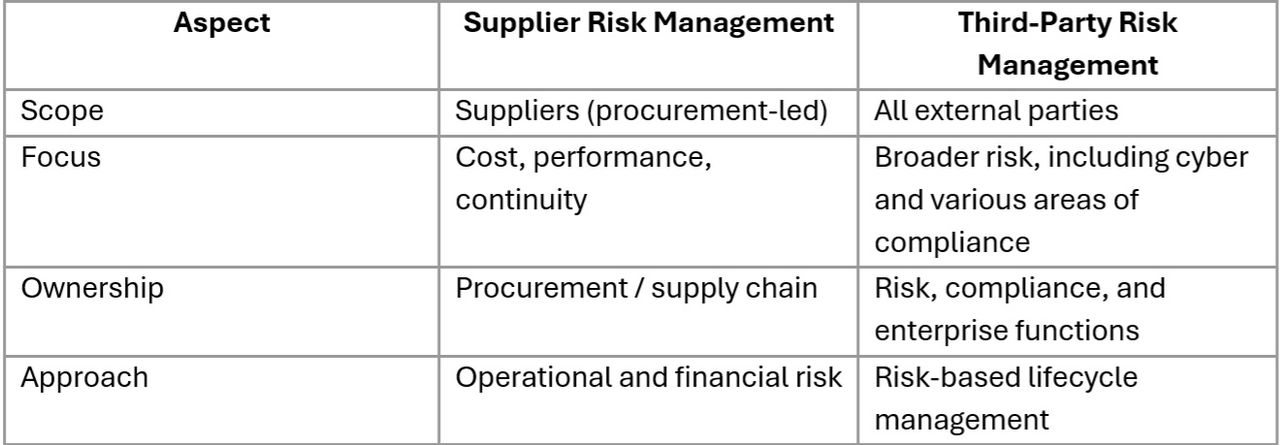
In many organizations, SRM forms part of a broader TPRM framework as risk considerations expand.
While approaches differ according to industry, business model, jurisdiction and other factors, both regulatory and industry guidance point to several common characteristics:
Risk-based segmentation
Not all third parties carry the same level of risk. Programs may help classify relationships based on factors such as business criticality, data access, and regulatory risk exposure.
Lifecycle management
Risk management may be best applied in a consistent way from onboarding through to termination, rather than at a single point in time.
Ongoing monitoring
Point-in-time assessments may in some cases be insufficient, given how quickly risk profiles can change across third-party ecosystems.
Cross-functional coordination
TPRM may bring together procurement, risk, compliance, legal, and technology teams to provide broader oversight.
Research carried out by Deloitte suggests that more mature TPRM programs may be associated with relatively stronger organizational outcomes:
While outcomes vary, these patterns suggest that consistency and governance can play an important role in managing external risk exposure.
TPRM appears to be moving beyond static, checklist-based approaches toward more integrated and data-driven models, as highlighted in industry research from KPMG:
Along with the ongoing adoption of technology, including AI-enabled tools to support dynamic risk management, these trends point to an ongoing shift toward more connected, intelligence-led approaches to managing third-party risk.
As TPRM matures, organizations may seek to bring together:
This data and technology can also support the move from periodic assessment to a more continuous understanding of third-party risk.
Moody’s capabilities align with this evolution by supporting:
Third-Party Risk Management has become a principal component of how organizations manage risk in a globalized, interconnected environment.
The risk of third party-related incidents, combined with growing regulatory expectations and increasing ecosystem complexity, means organizations may benefit from a structured approach to managing external risk factors.
At the same time, the evolution of TPRM toward more integrated, data-informed, and continuously monitored models may signal a broader shift in how risk is understood across the extended enterprise.
For more information about Moody’s solutions for third-party risk management, please get in touch with the team at any time. We would love to hear from you.
*Disclaimer: This content is for informational purposes only and does not constitute legal, financial, compliance or other professional advice. Please consult with a qualified professional for specific legal, financial, compliance, or other professional advice. For more terms and conditions pertaining to Moody’s products and services, refer to the https://www.moodys.com/web/en/us/legal/global-disclaimer.html on Moody’s website.