
Manufacturing companies today face unparalleled risk due to the convergence of external and internal influences on their supply chain security. The increasing complexity of global supply chains, conflating geopolitical tensions, and insufficient data and analytics for risk assessment and mitigation can complicate a corporation’s supply chain resilience strategy.
Understanding and evaluating supplier risk also remains challenging when related to production of niche goods – such as semiconductors for electric vehicles – is concentrated among a few suppliers. Companies along the value chain are not able to source alternative suppliers or diversify their supply chains as easily in the event of supply chain disruptions.
Other high-risk factors could compromise any company’s supply chain resilience. Businesses without access to relevant financial insights and analysis to predict near-term supplier performance accurately could suffer from disruptions. Changes in economic conditions, political tensions, or other “black swan” events – unpredictable outlier events with potentially dire consequences – can also impact the performance of suppliers. As a result of unforeseen disruptions, companies could incur reputational damage, increased costs from delivery delays, non-compliance violations and fines, and other additional production costs.
Companies exporting goods to the United States (US), the European Union (EU), and other major hubs are also bound by strict human rights due diligence (HRDD) guidelines. It is critical for these companies to have visibility over third-party risk, which includes knowing if forced labor is part of their supply chains.
As an example, the solar industry is one with a higher risk of exposure to forced labor in the supply chain, due to the concentration of resources and productions in certain restricted regions, such as the Xinjiang Uygur Autonomous Region (XUAR).
Businesses are increasingly impacted by new regulations necessitating better oversight of supplier relationships. As a result, companies are required to conduct ongoing monitoring to ensure they comply with regional laws and can mitigate risks before they snowball.
United States
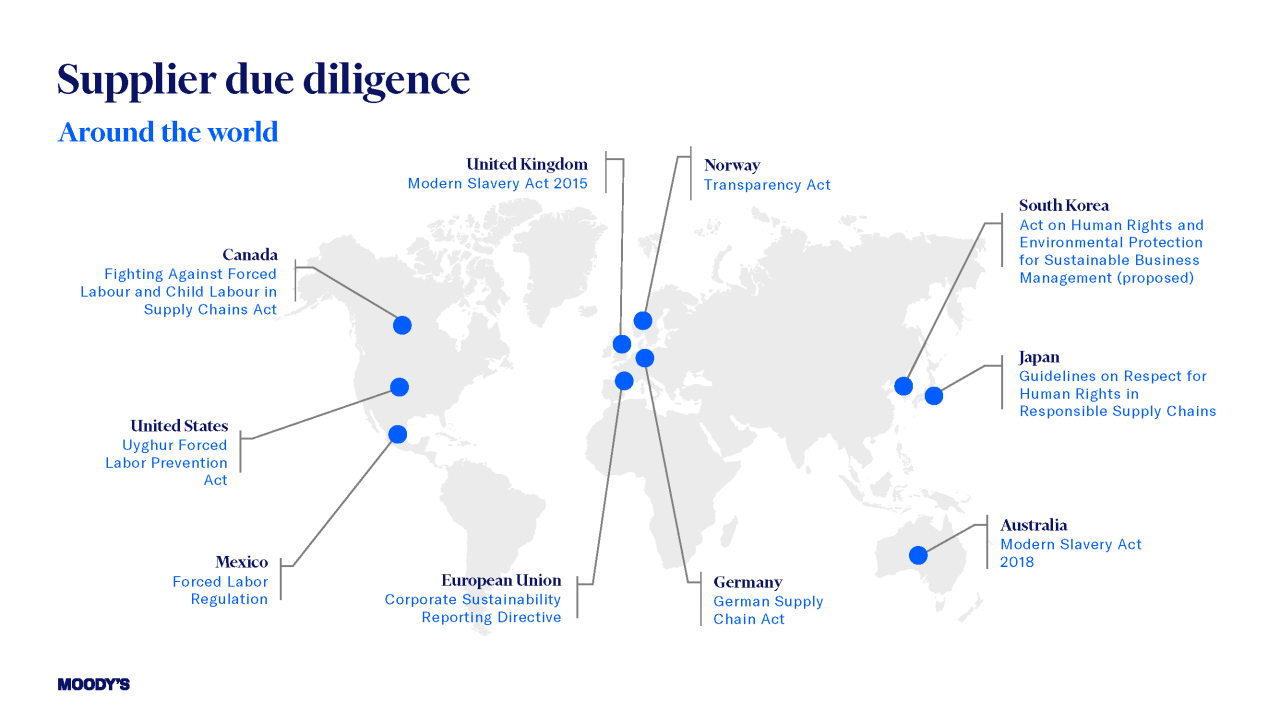
The Uyghur Forced Labor Prevention Act (UFLPA), enacted in 2021, restricts goods produced in XUAR or made by entities on the UFLPA Entity List from being imported into the US. Recently, an automotive company had thousands of cars impounded in US ports due to the presence of a subcomponent sourced from a banned region. Breaching the UFLPA led to supply chain disruptions and increased costs for the company, who has since sourced replacement parts for the impounded vehicles.
Europe
The German Supply Chain Act, introduced one year ago, has brought supplier due diligence into sharper focus. Under the Act, applicable organizations – German-based companies and foreign businesses with subsidiaries in Germany with over 1000 employees – must comply with supply chain due diligence and reporting requirements.
The Corporate Sustainability Reporting Directive is an EU law mandating that large companies and listed small-to-medium enterprises report the sustainability impact of their businesses. As part of this holistic environmental, social, and governance (ESG) assessment, businesses are also required to disclose their due diligence process for ESG impact in their supply chain. Non-compliance could result in large fines, an erosion of trust, or reputational damage to companies.
Asia
In 2022, the Government of Japan announced new Guidelines on Respect for Human Rights in Responsible Supply Chains. Although it is not legally binding, the guidelines promote adherence to HRDD in both upstream and downstream operations for Japanese enterprises.
South Korea proposed the Act on Human Rights and Environmental Protection for Sustainable Business Management. If enacted, the Act would mandate human rights and ESG due diligence for applicable South Korean enterprises – a first in mandatory reporting of HRDD and environmental due diligence in Asia.
Navigating risk is more complex than ever, so how can businesses improve supplier due diligence and risk monitoring to create more resilience and reduce exposure?
To help you map the appropriate tools to your supplier due diligence processes, consider the following questions:
Stage 1: Supplier due diligence and onboarding: Monitor for third parties who are sanctioned, and use data such as adverse media to check for risks of association with bribery and corruption.
Stage 2: Supplier risk monitoring: Integrate data checks to create a supplier risk profile and monitor for red flags on a continual basis – for example, jurisdictional risk and changes in ultimate beneficial ownership.
Moody’s offers tools to help businesses understand third-party risk holistically, providing visibility on the following four risk factors, and more:
In dealing with complex supply chains and multiple risk factors, companies that adopt a risk-based approach will be able to anticipate, assess, prioritize, and mitigate pertinent risks. The approach will be informed by a company’s risk policy and tolerance, which dictates risks that should be mitigated from those that are considered acceptable.
Improving third-party risk management will benefit companies by bolstering operational resilience, shortening supply chain recovery following disruptions, reducing the risk of fines for non-compliance, and avoiding reputational damage.
Moody’s can help you prioritize your risk mitigation efforts to concentrate limited resources on crucial tasks. Get in touch with Moody’s to find out more.