

From 2024 to 2025, financial institutions and regulated entities in Malaysia started preparations for the country’s fifth mutual evaluation by the Financial Action Task Force (FATF). FATF regularly reviews countries to assess their adherence to international standards in anti-money laundering and counter-terrorism financing measures (AML/CTF), based on the 40 FATF Recommendations. In 2025, FATF arranged on-site assessments and a plenary discussion to evaluate Malaysia’s progress against money laundering (ML), terrorist financing (TF), and proliferation financing (PF).
Recently, the FATF published Malaysia’s mutual evaluation report, which showed improvements in its technical compliance ratings and its assessment on the effectiveness of Immediate Outcomes.
Overall, the report noted Malaysia’s progress across different areas, which includes expanding data access and improving financial intelligence to support investigations; a robust framework for domestic and international cooperation; and Malaysian financial institutions’ sophisticated level of risk understanding.
Malaysia showed improvement in some of FATF’s Immediate Outcomes that measure effectiveness:
As highlighted in an earlier version of this blog prior to the 2025 report being published, Malaysia had taken steps to address areas where it was partially compliant in Recommendations 24 and 25 relating to BO and legal persons. In 2024, the Companies Commission of Malaysia issued updated guidelines for beneficial ownership reporting requirements and amended the Companies Act to improve corporate transparency and to support FATF evaluations. As part of the policy changes to strengthen its beneficial ownership reporting framework, the policy introduced a new definition of a “beneficial owner”, providing clarity on ownership and other means of control.
The report noted Malaysia’s progress in enhancing BO transparency and strengthening its BO framework, but the effectiveness could not be fully assessed at the time of the evaluation as some measures were implemented recently.
As a result of Malaysia’s legal and regulatory enhancements, its technical compliance ratings for Recommendations 24 and 25 are now ‘largely compliant’ and ‘compliant’ respectively, signaling improvement in reducing ML risk through the misuse of legal persons or arrangements. The country has crossed a significant milestone in having all 40 Recommendations rated as ‘largely compliant’ or ‘compliant’.
While some gaps may remain in verifying and enforcing BO obligations, Malaysia is well-positioned to continue strengthening BO transparency and ML, TF, PF risk mitigation efforts.
Following the adoption of Malaysia’s mutual evaluation report in 2015, the country has been subjected to increased scrutiny to gauge the effectiveness of its AML/CFT measures. Initially, Malaysia was rated partially compliant on Recommendations 7, 24, and 25. Since the evaluation, Malaysia has undertaken significant efforts to rectify the deficiencies in technical compliance noted in the report. These efforts include reinforcing their legal and regulatory framework related to AML and CFT and introducing new measures to address the gaps highlighted by the FATF.
Several measures were implemented within financial institutions, aimed at enhancing their risk assessment and management processes.
The first: The adoption of a more comprehensive and transparent risk-based approach. This approach entails a thorough evaluation of potential risks, taking into consideration a wide array of pertinent information to ensure a holistic understanding of the potential clients and their risks.
In addition, these financial institutions introduced more stringent enhanced due diligence (EDD) protocols. These measures are activated in scenarios where elevated risks are identified, necessitating a deeper investigation into the involved entities and transactions. This rigorous scrutiny helps in identifying and mitigating potential threats more effectively.
As a result of these new measures implemented, financial institutions gained a better grasp of how to incorporate diverse and comprehensive data into their risk analysis frameworks. This improved understanding enabled them to make more informed decisions regarding when to initiate de-risking procedures. Prior to this, de-risking or eliminating exposure to high-risk clients or sectors was rarely initiated. The financial institutions in Malaysia are now better at safeguarding their financial health and ensuring regulatory compliance.
As a result of some of these improvements, Malaysia’s subsequent evaluation, published in October 2018, showed progress in four Recommendations, with only Recommendations 24 and 25 rated as partially compliant.
The table below indicates the improvements and changes between the MER in 2015 and its technical compliance re-ratings in October 2018:
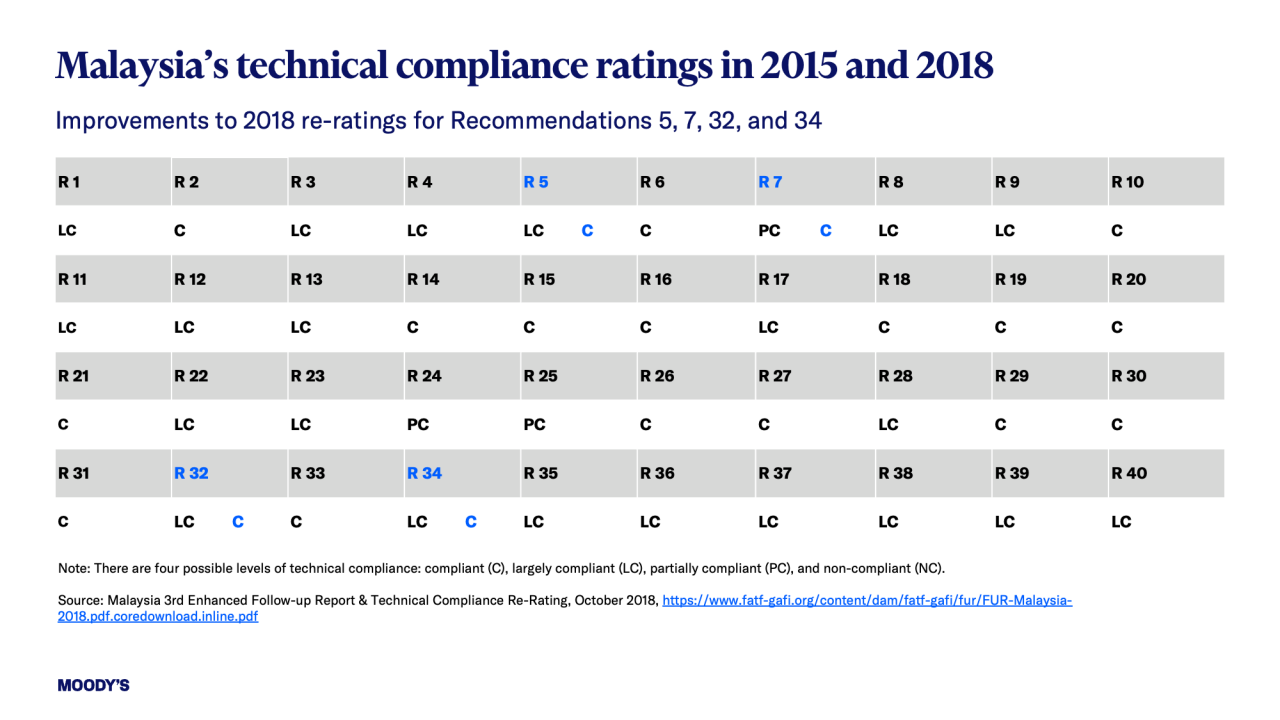
Malaysia has made strides in rectifying the areas where it had been partially compliant before. Moving forward, FATF suggests continuing to enhance transparency and identification of BOs. This area of focus is critical not only for Malaysia, it also represents a similar, widespread challenge among nations due to its association with the risk of evading sanctions. Addressing these concerns and promoting transparency is useful in mitigating the potential risks of sanctions evasion, another factor that could hinder a country’s economic activities, including investment and trade.
Enhancing the framework for transparency and beneficial ownership involves a multifaceted approach. It requires legislative changes, increased regulatory oversight and stronger enforcement mechanisms to ensure that the true owners of corporate entities are accurately identified and recorded.
Such measures are crucial for curbing illicit financial flows and combating financial crimes, which can erode trust in financial institutions and undermine economic stability.
For Malaysia, advancing in these areas could serve as a catalyst for economic growth. By demonstrating a strong commitment to international standards for financial transparency and combating money laundering and terrorist financing, Malaysia can bolster its reputation as a secure and reliable destination for international investment. This, in turn, would likely stimulate economic development, attract foreign direct investment and enhance the country’s overall trade opportunities.
The largely positive outcome of the report affirms the AML/CTF measures taken by the Malaysian regulator and financial services industry. In order to keep up with the AML/CTF changes and regulatory enhancements, Malaysian institutions and compliance practitioners can stay vigilant about emerging financial crime risks through scams, investments, or digital finance, as highlighted in the report.
From beneficial ownership data to AI-enabled workflows, Moody’s solutions can help organizations better understand the risks present in the dynamic landscape of financial crime. Get in touch today to learn how we can support your KYC and AML programs.