Business Entity Verification and ownership data

Build greater visibility into potential risks associated with third-party entities and ownership structures using business entity verification data. Combine links to official registry data and Moody’s global company data with sanctions and adverse media coverage to support your risk assessment processes.


Embed data into your defined workflows and develop contextual risk insights to support your analysis and help address the question: who am I doing business with?







Entity Verification API

With Moody’s Entity Verification API, you can access entity data from a broad network of commercial registers and financial authorities across 200+ countries and jurisdictions, along with compiled records covering millions of global entities and associated risk indicators.
 

You may need access to multiple data sources to conduct business entity verification. Moody’s configurable solutions offer access to global datasets and workflows to support your customer onboarding, client lifecycle management, perpetual KYC, third-party risk management, fraud risk management, and related processes.


A global Entity Verification case study

This case study highlights how a prominent global customer updated its KYC procedures using Moody's Entity Verification API. By integrating the solution, the customer sought to streamline operations and improve efficiency across its investment and commercial banking teams.


Woman smiling
Continuation of woman smiling image


Company ownership data and ownership structure insights


You can embed ownership data and corporate structure information to support the analysis of beneficial ownership relationships. Moody’s data includes ownership links across global entities, including active and historical ownership relationships.
 

Retrieve data and documents from official sources through automated entity verification queries, with timestamped records to support your internal review processes.


Review corporate group structures to assess ownership across potential and existing business partners and third parties. Enhance visibility into ownership relationships to support the analysis of indirect ownership, control, and circular ownership patterns within customer and counterparty networks.


Corporate registry data and official documents


Searches across a global register network can help support the identification and analysis of corporate entities and business details. These details may include:

  • registration number
  • registered name
  • address
  • directors and officers
  • entity status
  • original documents, such as register extracts, annual accounts, articles of association, and more. 

Connections to government registers and financial authority sources can be used to support entity verification processes, with timestamped data and documents to support your internal recordkeeping and audit processes. Coverage includes hundreds of millions of companies, with large volumes of company filings.


What our customers say


"Access to primary source registers via a single sign-on platform, broad country coverage, a Concierge and Translation Service… I don’t know any other company who is offering that. This puts us at a real competitive advantage."


Leading global data

Know your business (KYB) processes

Moody’s solutions support business entity verification processes by bringing together structured company ownership data and related information to help you build a more connected view of who you are doing business with and contextualize potential risk.   Moody’s solutions help:

  • Automate selected KYB tasks, including checks, to help reduce manual effort and support operational consistency
  • Incorporate sanctions, PEPs, and adverse media event data into customer due diligence processes
  • Analyze shareholder and ownership information to support the review of corporate structures


Common steps in an entity verification process


When reviewing the ownership of a legal entity, organizations may draw on a combination of data sources and checks, depending on their internal policies and regulatory obligations. These might include:

  1. Reviewing corporate documents
    Examining official records such as articles of incorporation, shareholder information, or constitutional documents for more visibility into how ownership is recorded.
  2. Ownership and control analysis
    Reviewing information on directors, officers, and shareholders to provide insight into ownership and control relationships, where data is available.
  3. Assessment of financial disclosures
    Using published financial statements or accounts to help surface disclosed ownership interests or equity stakes.
  4. Use of public records and registers
    Accessing corporate registries, filings, and register extracts to designed to support validating entity details and ownership information.
  5. Additional review of key individuals
    Applying additional review measures to certain individuals or entities where required by internal risk frameworks.

By bringing sources together as part of entity verification and customer due diligence processes, you can enhance visibility into entity ownership and structure, in line with your organization’s approach to anti-money laundering, sanctions, and related regulatory frameworks.


A study from Moody's

Entity Verification Report

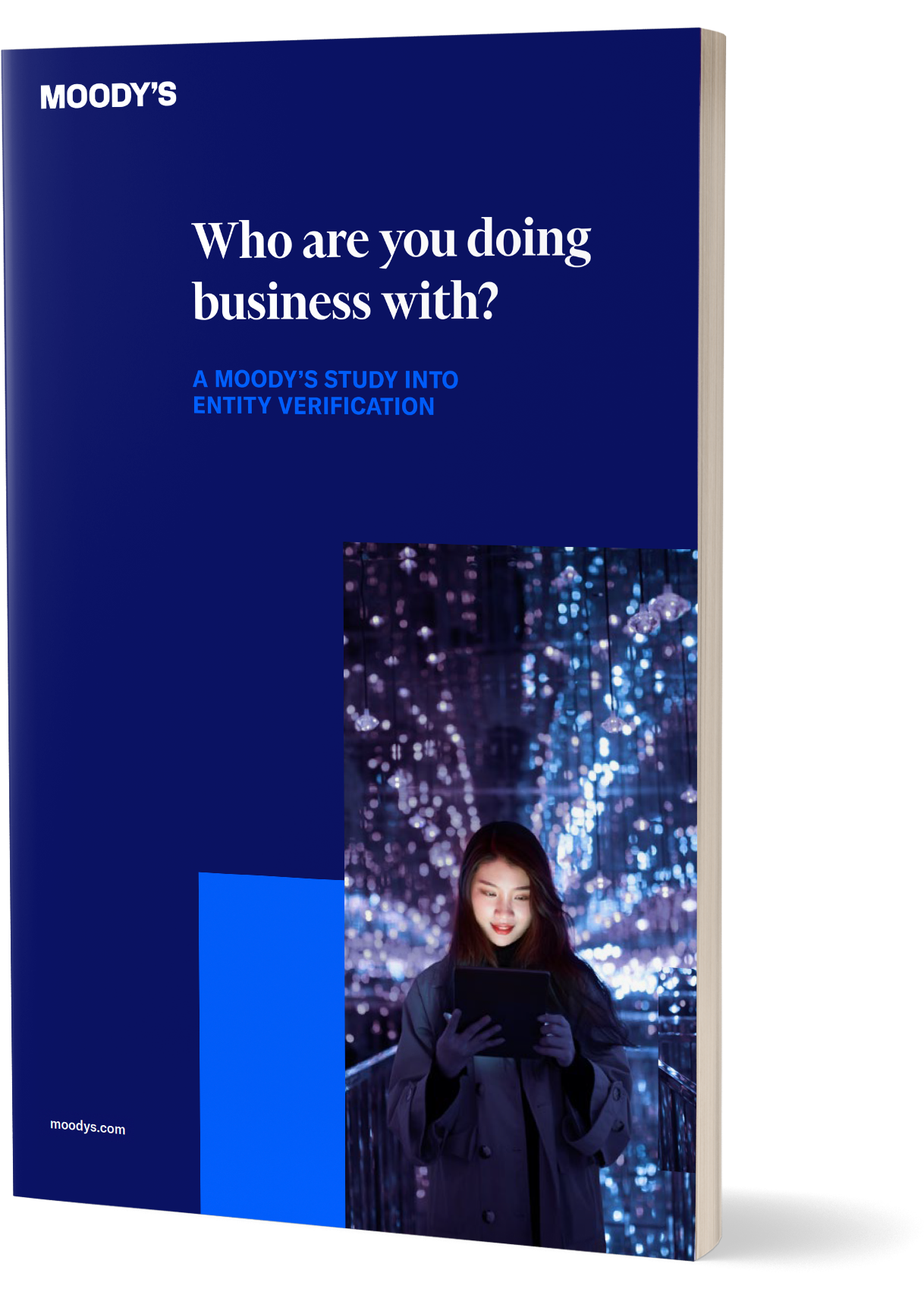
This global study highlights the increasing significance of entity verification processes in supporting risk management and addressing data-related challenges in today's regulatory and risk environment.

Download the report to learn what more than 350 risk and compliance professionals say about entity verification processes—spanning challenges, data governance, the rise of AI, and how senior leaders are prioritizing it.


Moody's entity management award


We’re proud to have been recognized in the Chartis Financial Crime Compliance 50, 2026, as category leader in Data Technology for Entity Management.

Chartis Financial Crime Compliance 50, 2026, in Data Technology for Entity Management

Entity Verification processes and ownership

Frequently asked questions

Image mosaic of smiling woman working on laptop
Continuation of image mosaic of smiling woman working on laptop


Business entity verification typically involves confirming that a legal entity exists and reviewing attributes, such as its registered name, status, address, and registration details. Company ownership data and official register information can support this process by providing more visibility into how an entity is recorded in source materials.

Verifying company ownership generally requires reviewing ownership and control information, commonly available through company ownership data, corporate structures, and official filings. This can help provide insight into who holds direct or indirect ownership interests based on the available information from public and proprietary sources. 

Ownership and control data often describes how a company is owned and influenced, including shareholdings, parent subsidiary relationships, and control links. This information can help provide context around corporate structures and the relationships between legal entities.

Company filings and register extracts are official documents often sourced from local commercial registers. They may include details such as incorporation records, registered addresses, directors or officers, and annual accounts, depending on the jurisdiction and availability of information.

Know Your Business (KYB) checks commonly involve collecting and reviewing information about a legal entity, including its identity, ownership structure, and registration details. Entity verification and company ownership data can support KYB processes by contributing structured information about business counterparties.


*Disclaimer: This content is for informational purposes only and does not constitute legal, financial, compliance or other professional advice. Please consult with a qualified professional for specific legal, financial, compliance, or other professional advice. For more terms and conditions pertaining to Moody’s products and services, refer to the disclaimer on Moody’s website.


More articles and resources on Entity Verification

With public access to beneficial ownership registries becoming more restricted, organizations face challenges in obtaining ownership insights. This paper explores how Moody's solutions bring together registry data (where permitted) and calculated ownership derived from multiple sources to support analysis of ownership structures, control, and influence across jurisdictions.

Entity verification research typically occurs during an onboarding process that might be carried out by a financial institution, such as banks, to comply with know your customer (KYC) and anti-money laundering (AML) regulations. However, looking for risks associated with entities in a business network is an ongoing part of compliance and risk management.

Know Your Business or KYB due diligence is essential when onboarding and monitoring corporate customers and suppliers as part of compliance and risk management. The onboarding program and ongoing risk reviews include several KYB checks that form part of an anti-money laundering (AML) and counter-financing of terrorism (CFT) program.

Read more about how EU beneficial ownership rules affect verification processes under AML regulations. Moody's empowers you with smart compliance and due diligence tools.


Get in touch

Request a demo

We would love to show you what Moody's solutions can do!

Book a demo or alternatively, keep reading to discover more about how Moody's solutions could help your organization.