
Could a data-driven, risk-based approach to third-party risk management (TPRM) help your organization make more informed decisions about who you work with?
Could a data-driven, risk-based approach to third-party risk management (TPRM) help your organization make more informed decisions about who you work with?
Moody’s solutions can bring together global entity intelligence, risk signals, and analytical context to help support third-party risk assessment across financial, compliance, and other operational areas.
Rather than treating third-party risk as a standalone workflow, the same underlying data can be applied across multiple use cases, including sanctions screening, adverse media, ownership analysis, sustainability, cyber, and financial risk to help teams work from a shared, data-driven foundation.

Interested in finding out more about our solutions? Our teams are ready to help.
Moody's for Compliance can help teams assess potential risks across a third-party network, including customers, suppliers, and extended networks such as your suppliers’ suppliers.
Assess risk signals across entities, including financial health and cyber risk, beneficial ownership and shell company indicators, to support a clearer view of who you’re doing business with.
Effective compliance and third-party risk management starts with building a structured view of who you are doing business with. Moody’s third-party risk management solutions can bring together entity identity, ownership structures, and risk indicators to support third-party onboarding, due diligence, and risk assessment in a single workflow.
Configurable processes can support consistent policy application, integrated checks, and case management, helping reduce fragmented activity while aligning onboarding with internal policies and compliance obligations.
Third‑party risk can evolve over time, making ongoing visibility an important part of compliance and third-party risk management. Moody’s third-party risk management solutions can apply the same data and analytics used at onboarding across the lifecycle of a relationship, supporting a more consistent approach to third-party risk assessment.
By combining global data coverage with monitoring capabilities, teams are able to track changes across ownership, sanctions exposure, adverse media, and other risk indicators, to support a broader view of third-party relationships across jurisdictions and operating environments.
Moody’s data, Ai-enabled analytics, and workflow capabilities support third-party risk activities across onboarding, due diligence, and ongoing monitoring.


Third-party risk management is often approached as a set of discrete tasks. In practice, it could be viewed as an ongoing lifecycle that connects how third parties are analyzed, assessed, and monitored over time.
TPRM programs are typically built on a consistent approach to identifying third parties, defined risk categories, and clear criteria for evaluating risk.
At this stage, organizations normally capture core information such as ownership and control structures, geographic footprint, and relevant risk indicators, creating a shared basis for assessing risk across suppliers, vendors, and partners.
Implementation may be reflected in repeatable workflows that connect onboarding, due diligence, and ongoing monitoring activities.
Risk checks, documentation, and escalation pathways are incorporated into defined processes, supporting coordination across teams and a shared view of third-party risk information.
As third-party networks change and risk exposure changes, TPRM programs are commonly revisited to assess coverage, consistency, and visibility.
Program evolution might look at how risk information remains current, comparable across regions, and aligned with internal priorities.
Viewed as a lifecycle, TPRM can function as an ongoing organizational capability, linking design, execution, and review through shared data, integrated risk perspectives, and coordinated workflows.
Get in touch to talk about how we can support your continuous TPRM program.
A model that helps unify people, processes, and technology can create greater visibility over where risks lie in a third-party network.
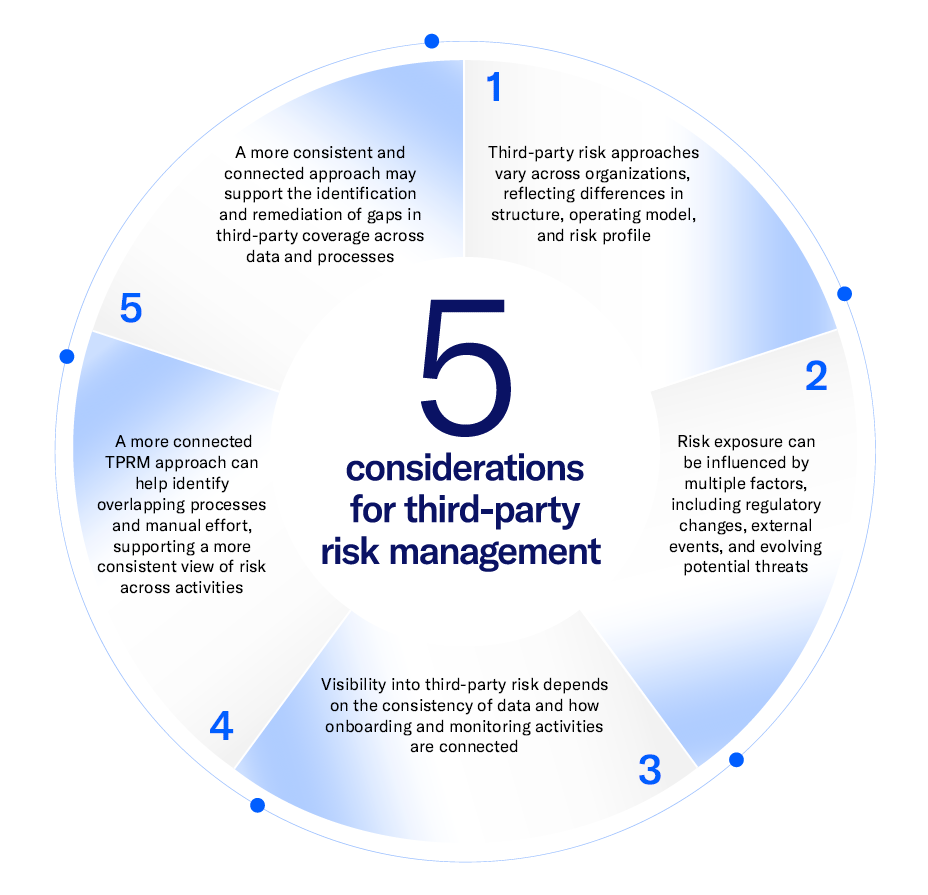
Here are 5 considerations for third-party risk management across your network.


See how we are working with our spotlight partners to meet customers where they need us most.


The Infinite Game is a Moody’s short documentary series that explores the complex world of financial crime, its hidden costs, and the measures taken to thwart it.
As some automakers bring battery production in-house, they're reshaping their supply chains and their risk frameworks. Explore 8 interconnected risks rewiring the EV value chain.

Third-Party Risk Management (TPRM) has emerged as a structured approach to help organizations understand and manage these risks, particularly as regulatory expectations; cyber threats, and operational dependencies continue to grow.

Supplier ecosystems continue to be substantially interconnected. Organizations now rely on complicated networks of third-party partners and suppliers to deliver goods and services.

Understand where third-party risks might be overlooked, the US and EU regulatory expectations reshaping trade and supply chains, and how organizations are beginning to turn compliance into a strategic advantage.

Energy supplier risk is becoming a core operational concern. Find out how geopolitical pressure, infrastructure renewal, and digitalization are reshaping dependencies, and why suppliers now sit closer to system resilience.

European Union (EU) rules on forced labor are tightening, with a new product ban and mandatory due diligence regime that looks set to transform expectations on how companies manage human rights-related risks in their supply chains.

The Bureau of Industry and Security (BIS), part of the US Department of Commerce, plays a key role in safeguarding national security and foreign policy interests through export controls. A central tool in this effort is the Entity List, which restricts certain foreign individuals, organizations, and government agencies from accessing US-origin goods, software, and technology.

Andrei Quinn-Barabanov shares practical ways to tackle three of the largest causes of cyber supply chain incidents that can negatively impact your company’s operations and performance.

With criminals using new technology and digital methods to launder cash, we explore these tactics, and the actions and regulations used to support AML and CTF efforts.

It is time to take stock of the world of UBO definitions, disclosures, and data—and consider its role in the fight against financial crime and money laundering.

On February 27, 2025, Chartis Research published its second Financial Crime and Compliance (FCC50) ranking and report. The FCC50 report evaluated nearly 300 vendors across core financial crime disciplines and identified 50 leaders in financial crime and compliance.

2024 has seen a lot of focus on one of the Financial Action Task Force (FATF)’s consultation processes in relation to proposed revisions of its Recommendation 16, commonly known as the "Travel Rule."

Know Your Business or KYB due diligence is essential when onboarding and monitoring corporate customers and suppliers as part of compliance and risk management.

Shell companies with no significant assets or business operations can be used for both legitimate and illegitimate purposes. Although shell companies are not illegal, financial criminals typically make use of them to disguise ultimate beneficial ownership.

Politically Exposed Persons or PEPs can be tied to various areas of financial risk—such as fraud, corruption, money laundering—making it important to understand if someone is a PEP before they are onboarded to your customer or supplier network.

Choon Hong Chua, Head of Financial Crime Practice Group for APAC and the Middle East, was recently interviewed by Singapore radio station MONEY FM 89.3. In this interview, he unpacks the wider impact of the recent money laundering case making headlines in Singapore.

New research released by Moody's has highlighted low awareness around the world about Politically Exposed Persons (PEPs) and the risks they can be connected to.
Please get in touch to discuss your approach to third-party risk management or supplier due diligence – we would love to talk to you.
*Disclaimer: This content is for informational purposes only and does not constitute legal, financial, compliance or other professional advice. Please consult with a qualified professional for specific legal, financial, compliance, or other professional advice. For more terms and conditions pertaining to Moody’s products and services, refer to the https://www.moodys.com/web/en/us/legal/global-disclaimer.html on Moody’s website.